The Atari 2600 was in continuous production for nearly 15 years with a variety of different models produced.
Models are arranged chronologically. Revisions are underneath their respective model.
Six Switch / Woody (1977-1982)
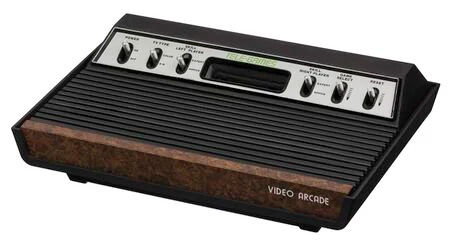
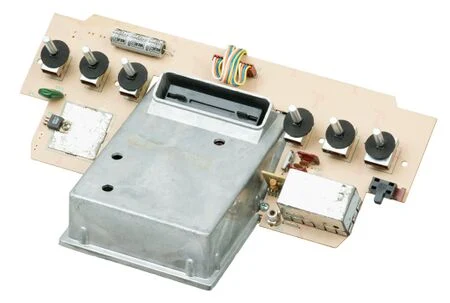
Branded as the "Video Computer System", these systems possess six switches on the top of the console and have an internal two-piece construction, with the switches, RF modulator and power circuitry residing on a separate board from the main board, the latter of which is housed in thick RF shielding due to strict FCC rules at the time. Both Atari and Sears-branded models exist for all six-switch consoles, with the Sears model being known as the "Sears Video Arcade". These are identical to their Atari-branded counterparts and were made on the same assembly lines, but have a different false woodgrain pattern and a silver inlay surrounding the cartridge port and switches.
"Heavy Sixer" CX2600 (1977-1978)
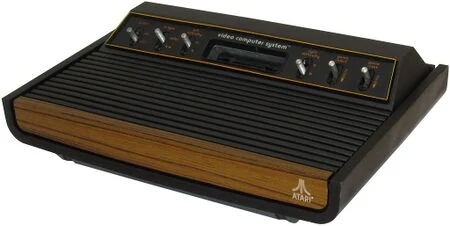
These are the first released models of the Atari 2600. The name "Heavy Sixer" is due to the fact that these consoles have a thick styrene bottom case, which adds considerable weight to the console. Most "Heavy Sixers" were produced in Sunnyvale, California, close by Atari's headquarters. During 1978, Atari also began manufacturing Heavy Sixer consoles in Taiwan. Due to their short production run, these consoles are somewhat difficult to find.
“Light Sixer” CX2600 (1978-1982)
 |
 |
 |
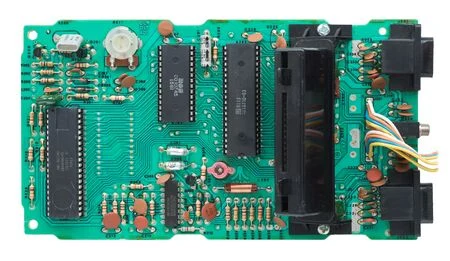 |
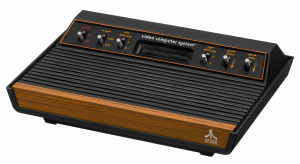
These make up the vast majority of six-switch Atari 2600s. Aside from minor board revisions, the only significant difference between these models and the "Heavy Sixer" is that they have a thinner, angled ABS bottom case, a change made to reduce production costs. The 7805 voltage regulator was also mounted flush to the switchboard on a metal plate to reduce problems with the regulator's leads cracking.[1]
Early "Light Sixers" were manufactured in Sunnyvale though most were made overseas in Taiwan and Hong Kong. They are easier to find than the “Heavy Sixer”, while offering zero feature sacrifice. Atari-branded Light Sixers were manufactured until very early in 1982, whereas Sears variants continued to be produced well into the year.
Four Switch (1981-1990)
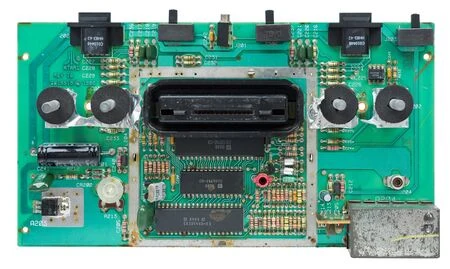
The first major revision to the Atari 2600 since its introduction. In an effort to further reduce production costs, the entire console was consolidated to a single PCB with thin RF shielding, as opposed to the six-switch's two-piece construction and thick shielding. The most notable external difference is that the difficulty switches were reduced to simple plastic slide switches and relocated to the rear of the console. In addition, the channel select switch was moved from the underside of the console to the rear, making it more accessible. All of the ports and rear switches are set at an angle to make them more visible and easier to access. This was also the first 2600 model to be sold in France, making its debut there in 1981. The French 2600 outputs a SECAM RF signal and has a very garish and limited color palette compared to NTSC and PAL models.
There are minor motherboard revisions for both four-switch variants, with the maximum extent being the addition of a timer chip in later board revisions, which eliminates the minor issue of reset failures upon powering on the console. Most later motherboard revisions also have an 820 ohm resistor soldered between pins 6 and 9 of the TIA chip to improve color saturation.[2]
CX2600A (1981-1983)
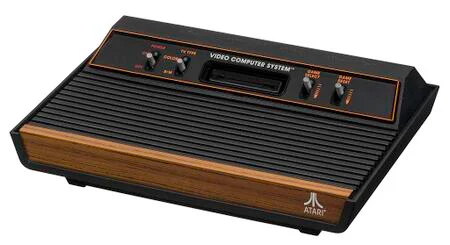
One of the most common 2600 variants as it was sold during the system's height of popularity, and still features the same false wood grain trim as on the six-switch consoles. This was also the last version of the 2600 to be sold as a Sears variant, which was not introduced until later in 1982. It was sold alongside the Sears Video Arcade II until Sears eventually started selling Atari-branded consoles as well as the Coleco Gemini clone during 1983.
Early NTSC 4-switch consoles reused leftover bottom shells for Light Sixers, with the rear port openings covered by a plastic label (though the holes for the channel select switch and unused screws were not). Most 4-switch consoles have a slightly redesigned bottom shell which blanked out these extraneous openings.
Atari 2600 (1983-1985, 1983-1990 France)
 |
 |
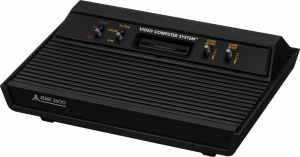
Commonly known as the “Darth Vader” model, due to its all-black appearance and lack of wood grain. Atari also officially rebranded the system as the "Atari 2600" with this variant, attempting to give the console a family look with the recently released Atari 5200. Outside of this visual difference, the "Vader" models are largely identical to the previous wood grain variant. Despite a corporate switchover during 1984, these continued to be manufactured into 1985. Late Vaders have a different model number, CX-2600CR, as they were sold in a cost-reduced package with only a single joystick and no pack-in game.
While the 4-switch console had been discontinued in most regions by the end of 1985, Atari continued producing SECAM 4-switch consoles with the "Vader" look until some time in 1990, well after the Jr. model's (detailed below) introduction elsewhere.
Sears Video Arcade II / Atari 2800 (1982-1983, US, Japan and Mexico)
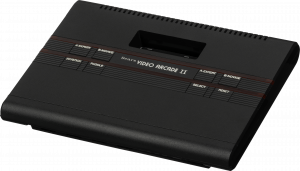
Perhaps one of the most unique variations of the 2600 hardware, this console was initially released in the US as the "Sears Video Arcade II" in late 1982, and in Japan and Mexico as the "Atari 2800" in 1983. This console features a sleek and relatively small case, which was later reworked for the Atari 7800. On the top of the console are the difficulty switches, Select, Reset and two buttons which switch the controller ports into either joystick or paddle mode. These latter two buttons are present because the console came bundled with unique controllers that combined the joystick and paddle controllers into a single unit. Because of this, the Video Arcade II/2800 is the only 2600 variant to have four controller ports. All four ports are located at the front edge, as is the power switch.
On the rear is a barrel jack for power, making the SVA II/2800 the only official 2600 variant to have such a connector (all others use a 3.5 mm mono jack). It is designed to accept a 9V AC power supply, but a DC power supply with sufficient voltage and current (9-12V DC, >500 mA) will work as well. As with most other 2600s, the RF cable is hardwired (but is connected to an internal RCA jack) and can be stored in a cable wrap molded into the bottom of the lower case. Both the channel select and TV Type switches are also located on the bottom.
Both the Sears Video Arcade II and Atari 2800 are almost completely identical, with the only differences being the nameplate on the console and the RF modulators being tuned for their respective countries. The Mexican Atari 2800 is totally identical to its Sears counterpart save for the nameplate, and has the same RF modulator (meaning it can be used on US channels 2 and 3). Most Sears consoles were manufactured in Sunnyvale while most 2800s were manufactured in Hong Kong.
2600 Jr. (1984-1992 PAL, 1986-1991 NTSC)
 |
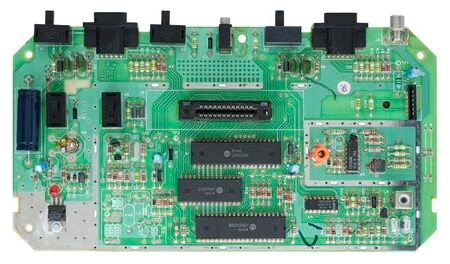 |
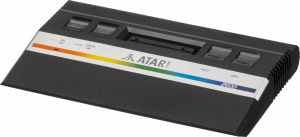
The final variation of the 2600 hardware, originally released in Europe in 1984 and the rest of the world in 1986. Though still officially branded as the "Atari 2600", this model is colloquially known as the "2600 Jr." due to its small form factor and PAL model number. Functionality is the same as the four-switch models, but the design has been significantly overhauled to be smaller and thinner to reduce production costs.
All Jrs have a distinctive faceplate in the center, usually made of aluminum. Early Jr. models have a faceplate with embossed "Atari 2600" text and a small rainbow underneath it, similar in style to the Atari 5200's faceplate. During 1986, the faceplate was changed to having an embossed Atari logo and a silkscreened rainbow that runs along its entire length. An early all-black variant exists, but its changes are entirely cosmetic. These all-black models were manufactured in Ireland and only sold in Europe.
The Jr. models tend to have poorer reliability, as Atari switched to using a mylar flex circuit for the Select and Reset buttons. This flex circuit tends to become oxidized and non-responsive, and may require outright replacement or modification of the console to use tact switches for these functions.
"Unicorn" variant (1988-1989)
Some later 2600 Jr. models also feature a cost-reduced chipset, with all three major chips (6507, TIA and RIOT) being consolidated into a single ASIC. This ASIC is known as the RP2A10 and was manufactured by Ricoh for Atari. These particular variants are highly difficult to find and are externally indistinguishable from other 2600 Jrs. Due to its rarity, it is commonly referred to as the "Unicorn" model.
Coleco Gemini/Columbia Home Arcade (1983-1984)
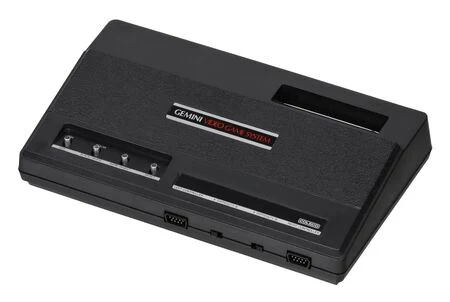
The Gemini is a clone of the Atari 2600 released by Coleco Industries in early 1983. At the time of its release, Coleco had been sued by Atari for alleged patent infringement, as the ColecoVision Expansion Module 1 used a reverse-engineered clone of the TIA graphics/sound chip, also used in the Gemini. The suit was eventually settled out of court and Coleco became a licensee of Atari patents, allowing Coleco to continue the sale of both products. A rare variant of the Gemini known as the Columbia Home Arcade also exists, which was sold by Columbia House in very limited quantities.
Although no different than official hardware in terms of functionality, the Gemini uses a completely different design language than any Atari hardware, with front-facing controller ports, an offset cartridge port and four small switches located at the front top of the console. The difficulty switches are located between the controller ports. At the rear are the RF out, channel select switch and 3.5 mm power jack, the latter of which uses the same pinout and specifications as an official 2600. Much like the Sears Video Arcade II, the Gemini came bundled with controllers that combined both the joystick and paddle into a single unit, albeit in a less sophisticated way as the actual joystick and paddle dial are separate. Since the Gemini only has two controller ports, Y-adapters must be used to connect another controller for paddle games. Standard 2600 joystick and paddle controllers can be used in the same way as official consoles.
The Gemini's internal construction is of noticeably lower standard than official Atari hardware, with a single-sided motherboard and lower quality components. It is not uncommon for Geminis to develop cracked solder joints on the controller ports, due to the single-sided motherboard and the fact that they are not reinforced. The cartridge port is secured with rivets, but this makes replacement of the port fairly difficult. Most of the Gemini's components are off-the-shelf save for the E4002 TIA clone, which is not completely pin-compatible with an Atari TIA.
Links
https://en.wikipedia.org/wiki/Atari_2600_hardware
https://www.atariage.com/2600/archives/consoles.html
http://www.retrogamescollector.com/spotters-guide-to-the-atari-2600-vcs-woody-junior/
https://theokoulis.com/index.php/2018/09/27/the-unicorn/
https://christmas.musetechnical.com/ShowCatalogPage/1983-Sears-Christmas-Book/0599
https://christmas.musetechnical.com/ShowCatalogPage/1984-Sears-Christmas-Book/0593