There are three main models of the Game Boy Advance, with only one of them receiving a significant hardware revision. All except for the Game Boy Micro are almost fully backwards compatible with original Game Boy and Game Boy Color games.
Game Boy Advance - AGB-001 (2001-2003)
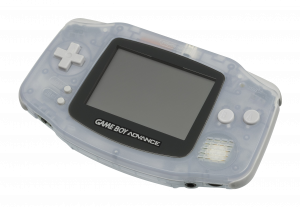
The initial version of the GBA hardware, first released on March 21, 2001 in Japan and during the summer of 2001 worldwide. It is the first Game Boy system to use a horizontal orientation, making it easily identifiable at a glance. Connectivity is similar to most other Game Boy systems, but omits the IR transceiver from the Game Boy Color and lacks an AC adapter input; AC adapters must use the battery contacts to provide power as a result. In addition, the GBA uses a dual LED power indicator, which lights up green during normal operation and turns red when the batteries are running low. This was also the last Game Boy to accept alkaline batteries, using two AA cells.
As with the Game Boy Color, the GBA has a non-backlit TFT color display, but is very difficult to see in anything other than direct light. As a result, lighting modifications have become commonplace, some of which even replace the entire screen with a modern IPS panel. Due to the GBA's unique shape and horizontal layout, certain accessories designed for this system will not work on later systems such as the SP or Micro.
Board Revisions and LCD Cable Differences
Most board revisions of the original GBA are fairly minor, as the AGB-CPU-01 through AGB-CPU-04 only have slight layout changes which do not impact functionality or modifications. The two earliest revisions, the CPU-01 and CPU-02, tend to have the original version of the CPU while later boards have the "A" revision CPU.
However, Nintendo skipped ahead from the CPU-04 to the AGB-CPU-10 in 2002, which has a different LCD interface compared to all previous revisions. This revision has a 32-pin LCD connector, whereas the CPU-01 through CPU-04 have a 40-pin connector. This difference is extremely important when ordering screen replacement mods[1], and systems with the 32-pin LCD also have improved battery life as they consume less current than 40-pin systems.[2]
Like previous Game Boy systems, the board revision number can be seen inside the battery compartment, visible through the hole for the battery cover clip. Systems with a 40-pin LCD have "01", "02", "03" or "04", while 32-pin systems have "10".[3]
Color Schemes
In keeping with tradition, the original GBA was available at launch in several colorways, with more being added during the system's life. Launch colors are in bold.
- Arctic White
- Black
- Fuchsia (clear pink)
- Glacier / Milky Blue (clear)
- Gold
- Indigo / Violet
- Jet Black (North America only, Toys 'R Us exclusive)
- Platinum
- Spice (orange, Japan only)
Numerous limited edition systems were also made available with bundles or as contest giveaways.
Game Boy Advance SP (2003-2009)
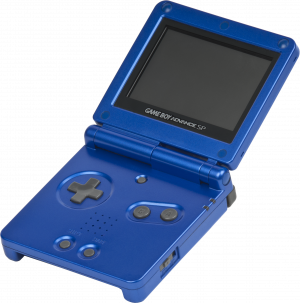
Released in early 2003 and replacing the original GBA, the Game Boy Advance SP has a completely different form factor as it returns to a vertical orientation from previous Game Boys, this time with a foldable clamshell design. Instead of using conventional alkaline batteries, the SP features a rechargeable (and user-replaceable) lithium-ion battery pack, which is charged through a proprietary connector on the top. To save internal space, Nintendo also consolidated the headphone jack into this connector, meaning that headphones must be connected though a special adapter. In another break from tradition, the D-pad and face buttons use metal tact switches instead of rubber membranes. The most significant change with the SP is its screen lighting, making it the first Game Boy system outside Japan to have any kind of screen lighting.
AGS-001 (2003-2005)
The original version of the SP (model number AGS-001) is the most common version and was released worldwide. It has a frontlit screen which can be turned on or off using a small button located under the screen on the main body. Most board revisions of the AGS-001 are largely identical, though the last revision (AGS-CPU-30) consolidates some ICs into the Mitsumi PM B3 chip. This also has the most color variations of all SPs.
AGS-101 (2005-2009)
Introduced in late 2005 alongside the Game Boy Micro (detailed below), the AGS-101 improves on the AGS-001 by adding a more vibrant and backlit screen. Unlike the 001, the screen lighting can only be dimmed using the brightness button and does not turn the backlight off. When the system is turned off, the 101's screen has a slight gray/green tinge, making it easier to identify if the model number label cannot be seen. The AGS-101 was not sold in Japan.
Only one board revision for the AGS-101 exists, designated the AGT-CPU-01. This board is not interchangeable with AGS-001 models and vice versa due to the screen lighting differences.
Game Boy Micro - OXY-001 (2005-2008)
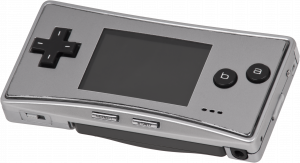
Released in late 2005, the Game Boy Micro is a shrunken down GBA, featuring interchangeable faceplates and metal construction. Like the AGS-101, the Micro has a backlit screen, which while smaller at only 2 inches diagonal (50.8 mm), has a finer dot pitch. It also has a rechargeable and user-replaceable lithium-ion battery like the SP, but unlike the SP, the Micro brings back the 3.5 mm headphone jack. Some concessions had to be made for the Micro's smaller size however, as the link cable port and charging port are combined into a single proprietary connector, requiring special cables or an adapter. Most notably, the Micro is only compatible with Game Boy Advance games and does not work at all with original Game Boy or Game Boy Color games.
Compared to previous Game Boy systems, the Micro sold fairly poorly[4] and Nintendo put little effort into marketing the system after its release. This was largely due to the release of the Nintendo DS a year prior, which was backwards compatible with GBA titles and was only slightly more expensive than a Micro. Nintendo had also released the AGS-101 revision of the SP almost simultaneously with the Micro outside of Japan, which retailed for $20 less than the Micro and offered better hardware and software compatibility.
Links
https://gbhwdb.gekkio.fi/consoles/agb/
https://gbhwdb.gekkio.fi/consoles/ags/
https://en.wikipedia.org/wiki/Game_Boy_Micro
https://en.wikipedia.org/wiki/Game_Boy_Advance
https://retrogamebuyer.com/gba-sp-ags-001-vs-101/
https://en.wikipedia.org/wiki/Game_Boy_Advance_SP
https://gametrog.com/nintendo-game-boy-advance-information-specs/