There are only two main models of the Sega Saturn, with numerous motherboard revisions within each model. Both models are functionally identical and have the same dimensions. The rear port arrangement is identical, with both models featuri…
11 min readUpdated Oct 9, 2026
There are only two main models of the Sega Saturn, with numerous motherboard revisions within each model. Both models are functionally identical and have the same dimensions. The rear port arrangement is identical, with both models featuring a 10-pin mini-DIN connector for AV out, a rectangular serial and MIDI communication port, and the power connector, which is a non-polarized IEC C8 connector on all except US consoles. Also at the rear is a panel which conceals the CR2032 battery slot (which powers the real-time clock and save memory), expansion slot for MPEG/Video CD playback cards, and on earlier models a reset button for the internal memory.
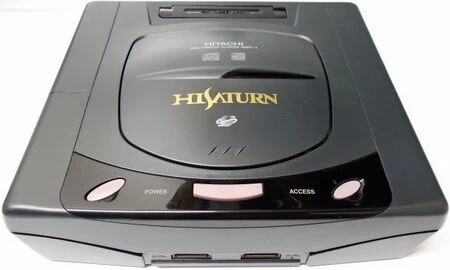
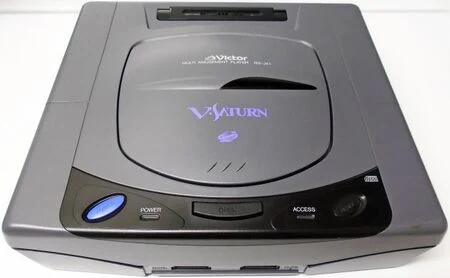
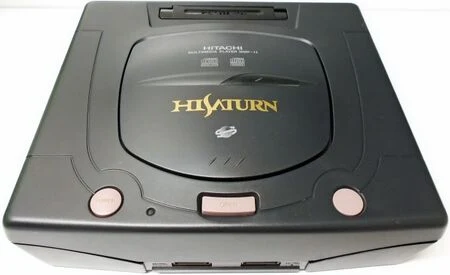
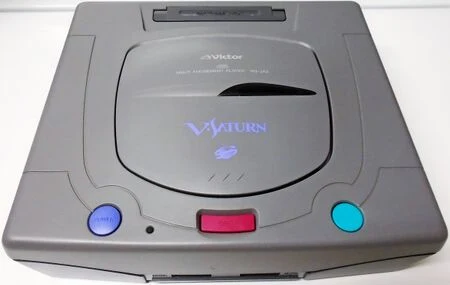
Both models were also sold by electronics companies Hitachi and JVC/Victor in Japan, but these are simple rebadges and are largely identical to the standard Saturn except for the BIOS splash screen. Hitachi also sold a unique variant which is not based on either model (detailed below).
Model 1 (1994-1996)
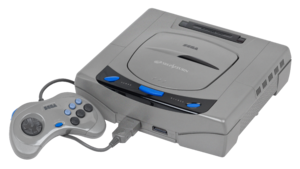
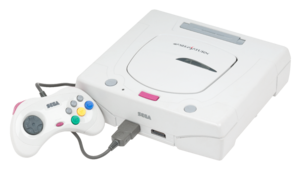
A Japanese model 1 Sega Saturn with matching controller.
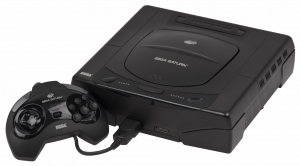
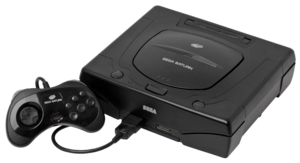
A US model 1 Sega Saturn. The PAL version is identical in appearance. Note the different controller design, which was packaged with the model 1 outside Japan.
A model 1 Hitachi Hi-Saturn.
A model 1 Victor V-Saturn.
This is the original version of the Saturn, introduced on November 22, 1994 in Japan and during the summer of 1995 elsewhere. It can be easily recognized by its oval power and reset buttons, surrounded by a glossy bezel (matte on the V-Saturn). The model 1 is also the only main Saturn model to have a disc activity LED (labeled "Access"). Japanese and NTSC Asian consoles have a brownish gray shell with blue buttons while all other regions have an all-black color scheme. Early Japanese consoles with the VA0 board revision have the model number HST-3200 while Japanese model 1s with later revisions have the model number HST-3210. All US model 1s have the model number MK-80000, PAL model 1s MK-80200-50, NTSC Asian model 1s MK-80200-07 and PAL Asian model 1s MK-80205-07. In Brazil, distributor Tec Toy opted to sell US consoles modified for PAL-M video output rather than produce their own.
VA0 (1994-1995)
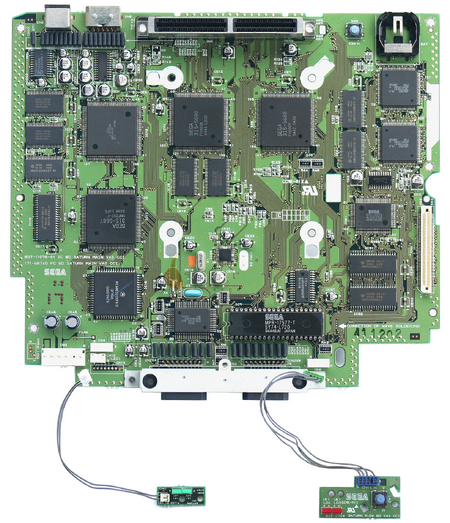
A Japanese VA0 board with attached sub boards for the LEDs and reset button.
Initial revision for all regions
Easily discerned by the "T"-shaped power connector at the rear, with Japanese consoles having an extra screw at the lower left corner to help secure it
US consoles have a unique D-shaped IEC power connector instead of the IEC C8 connector used in all other regions
Has the most complex internal construction of all Saturn revisions
The power supply is mounted inside the top case, as are the two LEDs, reset button, and disc door pinswitch, which are all connected to the motherboard using a number of wire harnesses
The CD processing hardware (SH-1, OCU and CD buffer RAM) is on a separate daughterboard (known in service documentation as the "SH1 Board"[1]), which also has the expansion slot for MPEG/VCD cards and the 20-pin connector for the optical drive
Only revision (along with the VA0.5 and 0.8) to use a 40-pin DIP BIOS chip; all later revisions used a surface-mount chip for the BIOS
Has the v1.00 BIOS
Very early-numbered Sega VA0s (usually around the hundred-thousands or lower) use a socketed EPROM BIOS chip instead of a mask ROM BIOS chip
Uses the 315-5746 (Hitachi HD49422) PLL clock generator chip, a currently irreplaceable IC that is very sensitive to heat
PAL VA0s have an unused footprint near the battery holder intended for a 50/60 Hz switch, facilitating easy region mods
Japanese VA0s have extraneous vents on the front left-hand side which were intended for a PSU cooling fan, but this was omitted prior to the Saturn's release
Hi-Saturns with this revision have the model number MMP-1 while V-Saturns with this revision have the model number RG-JX1 (no suffix)
Board Part Numbers
171-6874D (Japan)
171-6962B (US)
171-6963B (PAL)
VA0.5 (1995)
Almost identical to the VA0, but relocates resistors R133 (SSCK pull-up) and R134 (SRXD pull-up) to the underside of the board
Board Part Numbers
171-6874E (Japan)
VA0.8 (1995)
Practically identical to the VA0.5
Mainly found in Taiwanese-built US consoles
Board Part Numbers
171-6962C (US)
VA1 (1995)
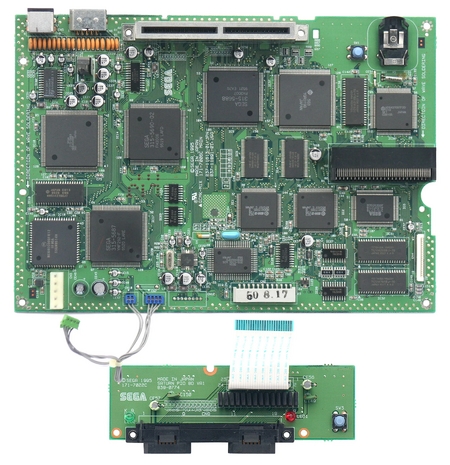
An NTSC VA1 board with separate controller board at the bottom.
Introduced in mid-1995, soon after the Saturn's North American and European releases
Has a greater deal of internal consolidation compared to the VA0
Power supply is connected directly to the motherboard using a 5-pin header and resides in the bottom case
SH-1 Board, rear expansion slot and disc door switch are integrated into the motherboard
In order to make room for the CD hardware, a number of ICs were moved to the underside including the BIOS ROM and save RAM
Controller ports, LEDs and reset button are placed on a separate PCB, connected to the motherboard with a short flex cable
Beginning with this revision, US consoles use a polarized IEC C8 connector for power
Last revision to use surface-mount electrolytic capacitors
Last revision to have a 20-pin optical drive connector
Consoles with this revision have a "1" as the third digit in the serial number
Hi-Saturns with this revision have the model number MMP-1-1, while V-Saturns with this revision have the model number RG-JX1(X)
First revision to use through-hole electrolytic capacitors throughout the entire console
First revision to use a 21-pin connector for the optical drive
Not found in PAL consoles
Consoles with this revision have a "2" as the third digit in the serial number
Hi-Saturns with this revision have the model number MMP-1-2, while V-Saturns with this revision have the model number RG-JX1(Y); these also apply to the VA SD (detailed below)
Board Part Numbers
171-7128B
VA SD "VA3" (1995-1996)
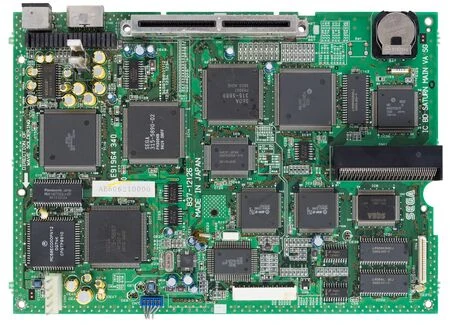
A VA SD board along with the controller port board.
Mostly identical to the VA SG but uses SDRAM instead
Not found in US consoles
Last revision to use a 5-pin power supply across all regions
Board Part Numbers
171-7130B (NTSC)
171-7131A (PAL)
Model 2 (1996-1998)
A Japanese model 2 Saturn with matching controller.
A US model 2 Saturn. The PAL model 2 is nearly identical in appearance but has gray buttons. By the time of the model 2's release, Sega began using the original Japanese controller design worldwide.
A model 2 Hi-Saturn.
A model 2 V-Saturn.
Released in 1996, the model 2 is a cost-reduced revision which mainly differs from the model 1 in cosmetic appearance. Game and accessory compatibility is the same as the model 1 (except on later board revisions, detailed below). Both the power and reset buttons are now circular, with the bezel surrounding them being omitted. The drive activity LED was also removed, and the door release button is smaller and slightly recessed. While PAL territories, South Korea and the US continued using an all-black color scheme, Sega switched to a lighter off-white color in Japan and even introduced special "Skeleton" consoles in 1998 which used a dark transparent shell. By the end of 1997, Sega had discontinued production of the Saturn for all regions outside Japan due to poor sales. Production for the Japanese market continued for another year, ending as the introduction of its successor became imminent.
Japanese model 2s have the model number HST-3220, US model 2s MK-80000A, PAL model 2s MK-80200A-50, NTSC Asian consoles MK-80217-07 and PAL Asian consoles MK-80219-07. Brazilian distributor Tec Toy took the same route as they had with the model 1 and sold modified US consoles with PAL-M output. When Sega discontinued the Saturn for the US in 1997, Tec Toy switched to modified Japanese consoles.
VA SG "VA2" / "VA4" (1996)
This is the earlier revision of the model 2 and was previously used in the model 1, with the only changes being the omission of the drive access LED on the controller port board and memory reset button near the battery holder. Consoles with this board have a "2" or "4" as the third digit in the serial number. As with the model 1, this board was not used in PAL consoles.
VA SD "VA3" / "VA5" (1996)
Used alongside the VA SG and was also previously used in the model 1, though it made its first appearance in US consoles beginning with the model 2. Consoles with this board revision have a "3" or "5" as the third digit in the serial number.
VA6 SG (1996)
Has even more internal consolidation, with the controller port board being fully integrated with the motherboard
First to use a 4-pin power supply header for NTSC consoles; the 9V DC output pin was removed as it was unnecessary on NTSC consoles
Both the SH-1 and OCU are combined into the 315-5962 (Hitachi YGR022) chip, though the CD buffer RAM is still discrete
First revision to use the Cypress CY2292SC PLL chip, an off-the-shelf component which is more reliable than the original Hitachi PLL
Uses SGRAM
Only used in NTSC consoles
Consoles with this revision have a "6" as the third digit in the serial number
Board Part Numbers
171-7207A
VA7 SD (1996)
Almost identical to the VA6 but uses SDRAM
PAL boards retained all five pins on the power header as 9V DC is needed on the AV out for SCART aspect ratio autoswitching
Consoles with this revision have a "7" as the third digit in the serial number
Board Part Numbers
171-7208C
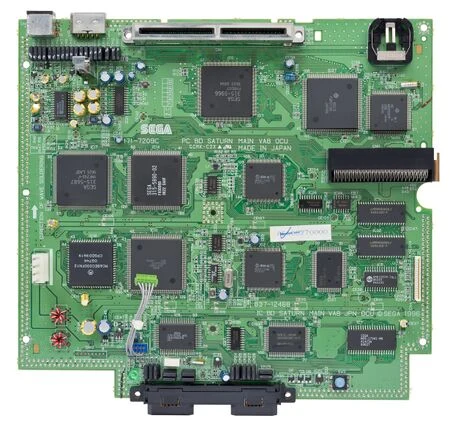
VA8 OCU (1996)
A VA8 board taken from a Japanese Saturn.
Similar to the VA6 but went back to using separate SH-1 and OCU chips (hence the "OCU" in the name)
The official reason behind this change is unknown, but may have been done to use up excess parts inventory as it was produced alongside the VA6 and VA7
Uses SGRAM
Only used in NTSC consoles
Consoles with this revision have a "8" as the third digit in the serial number
Board Part Numbers
171-7209C
VA9 (1996)
Only board revision to use the same layout for both NTSC and PAL consoles
Uses separate SH-1 and OCU chips like the VA8, would be the last revision with this setup
Went back to the original Hitachi PLL chip, previously used until the introduction of the VA6
Uses SDRAM
Only found in PAL consoles, Hi-Saturns and V-Saturns; this is the only known board revision for model 2 Hi-Saturns
Seemingly not used in US or Sega-branded JP consoles
Consoles with this revision have a "9" as the third digit in the serial number
Board Part Numbers
171-7291B
171-7291C
VA10 OCU (1996-1997)
Both the Motorola 68000 sound CPU and SCSP sound processor are now integrated into a single IC, the 315-5965 (Yamaha YMF713-S)
This change introduced certain 68000 code issues, causing compatibility problems with several games such as Space Harrier and OutRun; Sega would put out a revised print run of these titles which were compatible with VA10 and newer consoles
Last revision to use SGRAM
Went back to using the 315-5962 CD processing chip introduced in the VA6 and VA7
Some VA10s also have a small "bodge" board located near the VDP1 chip consisting of two 74HC161s and a 74HC00. This board serves as a clock divider circuit, providing an 8.4 MHz clock signal which is fed into the PLL
Consoles with this revision have an "A" as the third digit in the serial number
Only used in NTSC consoles
Board Part Numbers
171-7287C
VA11 (1996-1997)
Largely identical to the VA10, but the audio amplifier (in the upper left-hand corner near the AV port) is a TSOP form factor rather than SOIC
Some boards have the bodged clock circuit PCB also found in some VA10s
Consoles with this revision have a "B" as the third digit in the serial number
Only found in NTSC consoles
Board Part Numbers
171-7288B
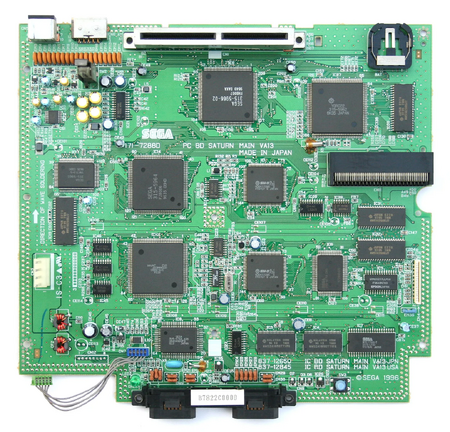
VA13 (1997)
A VA13 board taken from a Japanese Saturn.
Final revision for consoles outside Japan and other parts of Asia which used NTSC
Mostly the same as the VA11 but incorporates the "bodge" board found in some VA10 and VA11 consoles
First revision found in "Skeleton" Saturns (specifically consoles that were part of the 1998 "Special Campaign Original" giveaway)
Consoles with this revision have a "D" as the third digit in the serial number
Board Part Numbers
171-7288D (NTSC)
171-7455D (PAL)
VA15 (1997-1998)
Only found in Japanese and NTSC Asian consoles, including most "Skeleton" model 2s
Final Saturn revision overall
Both SH-2 CPUs are combined into a single CPU chip, the 315-6018 (Hitachi HD6417098)
Consoles with this revision have an "F" as the third digit in the serial number
Board Part Number
171-7462B
Game & Car Navi Hi-Saturn (1995)
Hitachi also sold a unique Saturn variant in 1995 called the Game & Car Navi Hi-Saturn, often known as the Hi-Saturn Navi or simply the "Navi". Considerably smaller and slimmer than a standard Saturn (due to using an external 12V power supply), the Navi was intended for use in a vehicle and featured an input for a GPS receiver. When combined with an optional LCD screen, the Navi could serve as a GPS navigation system with maps being provided on special CDs. The Navi also featured a mono AV input and TV tuner connector for watching content on its attached screen, and even featured microphone inputs with audio effects for karaoke. Aside from these special features, the Navi is mostly functionally identical to a regular Saturn and is compatible with all games and accessories. However, the Navi lacks RGB output despite having the same mini-DIN connector as a standard Saturn. This can be remedied with a simple RGB mod as it uses the same CXA1645 video encoder as most Saturns.[2]
Due to its extremely short production run and very high retail price of over 150,000 yen, the Navi is extremely rare and has since become a sought-after collectors' piece.