Page content & researching collaboratively taken from io55.net's PS Vita page with permission.
There are four main Vita models, three of which being handheld models.
Retail Models
Models are arranged chronologically.
These are the standard devices you bought from an electronics store.
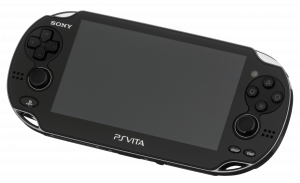
PCH-1xxx "Phat/Fat/OLED" (2011-2014)
The fullest-featured version of the PS Vita. It is sometimes nicknamed "phat" or "fat" due to it having the largest size, or nicknamed "OLED" due to its display technology. Easily identified by its flat metal trim surrounding the body, having oval-shaped home/start/select buttons, and a glossier front panel. Featuring an OLED screen, a proprietary charger, and no usable internal storage by default. The biggest reason one would prefer a PCH-1xxx series Vita over a "slim" PCH-20xx is for the OLED panel. The OLED screen adds a color depth and screen quality not found on PCH-20xx consoles.
The analog sticks of these models also use magnetic sensors, which don't have nearly as much risk of the sensors physically degrading overtime and developing stick drift, like traditional potentiometer sensors do. However, on this particular handheld, it also has the downside of replacements being uncommon and quite expensive, as they are boutique sticks not used on any other device. It may be wise to get analog stick covers if one plans on buying an OLED model over a "slim" model, so that the rubber on the top of the sticks won't have as much risk of being damaged.
PCH-11xx "3G" (2011-2013)
The PCH-11xx has a SIM card slot on the left side of the console, unlike it's non-3G counterpart. Its 3G modem introduces a useful mod not possible on the other models. To be specific, it is possible to replace the 3G modem with an SD card reader called PSVSD. To compliment a PSVSD, it is also possible to (optionally) replace the SIM card tray for a MicroSD slot with a microSD extension cable. Such a mod allows the usage of a game cartridge and MicroSD card at the same time; whereas the PCH-10xx and 20xx Vitas need an SD2Vita which normally occupies the cartridge slot. The PSTV/PS Vita TV doesn't have this issue, as it has a USB port.
PCH-10xx "Wi-Fi" (2011-2014)
Identical to the PCH-11xx series, except there is no 3G modem. Thus, all other characteristics from the PCH-11xx apply to this model. The lack of the connector and various SMD components for a 3G modem makes an internal MicroSD card mod difficult, as you would have to solder in order to install a PSVSD modification, whether it be directly to the motherboard or adding a miniPCIe slot back to the motherboard. However, the extra space on the inside from not having the modem does allow for more hardware mods, like even larger extended batteries.
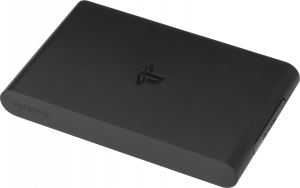
VTE-10xx "PlayStation TV" or "PS Vita TV" (2013-2016)
Differing greatly from other Vita models, the PSTV is essentially a consolized PS Vita. Very easily identified by its sleek and small “flat plate” form factor that has no screen. In Asian regions, the console was given the more accurate name of the PS Vita TV.
Connects to DualShock 3 and DualShock 4 controllers in replacement of the Vita's normal controls. The DualShock 4's touchpad can also be used to directly emulate the Vita's touch screen & touchpad.
Unlike retail handheld Vitas, the PSTV also features a USB-A port. The USB port can function similarly to a PSVSD on a PCH-11xx console, where extra storage doesn't need to interfere with the game cartridge slot.
The one obvious benefit of the PSTV is that it allows playing Vita games, homebrew, and other-such software on one's TV without needing a computer. In fact, homebrewing is almost a must for the PSTV, as a large amount of Vita software will refuse to work on the PSTV due to Sony-added limitations that aren't even necessary.
Another benefit to the PSTV is that you can capture native video from one of these consoles with a capture card, however every PSTV system will have hardware enforced HDCP that can't be bypassed even on a modified console, and has to be stripped with external solutions.
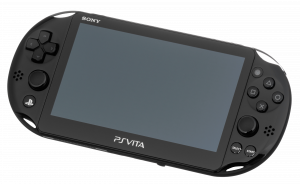
PCH-20xx "Slim" (2013-2019)
A drastic revision to the retail Vita handheld SKUs, which saw several changes compared to the PCH-1xxx series. It is often nicknamed the "slim" model due to its smaller size. It is easily identified by the home, start, and select buttons being perfectly circular with the plastic body having an all matte finish. This model also has a rounder appearance with no aluminum bezel on the edges unlike the OLED models.
Compared to the PCH-1xxx, it improved battery life (Revised SoC), ergonomics, replaced the proprietary UDC port to be standard MicroUSB, added 1 GB of usable internal memory, reduced weight and thickness, and replaced the 1xxx's OLED panel for an IPS one. There is also no 3G version of the PCH-20xx SKU, as the 3G equipped PCH-11xx models were already discontinued in 2013.
The analog sticks on the PCH-20xx series also use traditional potentiometer technology, whereas the PCH-1xxx series used sticks with magnetic sensors. This means that the analog sticks on the Slim Vitas could potentially be less reliable than the OLED Vitas, but stick replacements for PCH-20xx models are also far more common and much cheaper.
Both the PCH-20xx and PCH-1xxx are quite evenly matched as devices, since the loss of the OLED screen in the 20xx was essentially “made up for” with the introduction of the previously mentioned general improvements found in the 20xx, and the IPS screens used by the PCH-20xx models are still decent quality in their own right.
Testkit Models
PS Vita testing kits (model codes listed as PTEL-XXXX) have the same physical hardware as retail models, but with special firmware that has extra game debugging features, in addition to sideloading content you made with the official SDK.
Due to these being intended for game developers rather than for consumers, you could only buy PTEL devices directly from Sony if you were partnered as a PlayStation game developer.
While not being as many features as fully fledged PDEL dev kits, test kits were still useful to many developers due to their severely reduced cost.
Since they're basically the same as retail, the hardware features of PTEL-10XX (OLED) and PTEL-20XX (Slim) will also have the same differences, Sony also never offered 3G capable testing kits.
Devkit Models
TBW
Motherboard Revisions
Each version of the PS Vita also had at least two or more motherboard revisions. Not much is documented about them, so if you have more information on the differences, then let us know!
PCH-1xxx
IRS-002
Initial consumer release. Comes with the older 45 nm CXD5315GG SoC.
IRS-1001
Seen on very late revisions of the PCH-1xxx consoles, usually on the Cosmic Red and Sapphire Blue editions. It has the revised CXD5316GG with increased power efficiency, but curiously restricts the maximum charge capacity of the battery to around 4.05v (82%).
VTE-10xx
DOL-1001
Initial consumer release of the PSVTV/PSTV motherboard. Comes with the old 45 nm SoC.
DOL-1002
Revised PSTV motherboard with the more power efficient SoC.
PCH-20xx
USS-1001
Initial release of the PCH-20xx motherboards.
USS-1002
Revised PCH-20xx motherboard. Had a slight SoC revision named CXD5316BGG.
Region Codes
View the Region Information page for more information.
References
https://en.wikipedia.org/wiki/PlayStation_TV
https://en.wikipedia.org/wiki/PlayStation_Vita
https://retrogamebuyer.com/ps-vita-1000-vs-2000/
https://www.reddit.com/r/vita/comments/lw5frh/pros_cons_of_ps_vita_1000_ps_vita_2000/