| Information | ||
|---|---|---|
| Brand | Sony | |
| Type | Consumer | |
| Model Series | PRISM | |
| Tube Series | Trinitron | |
| Size | 40cm (~16") | |
| Viewable Size | 38cm (~15") | |
| Mask | Aperture Grille | |
| Regions | NTSC-J | |
| 240p/480i | Yes | |
| 480p | No | |
| Widescreen | No | |
| RF | VHF/UHF (rear) Type-F Hit RF (front) |
|
| Audio Output | KV-16D1:
TS 3.5mm line (x2 mono, front) Dual RCA (x1 stereo, rear) TRS 3.5mm line (1x stereo, rear) |
|
| Speakers | 2W (1x, front) | |
| Dimensions | Width: 405mm
Depth: 422mm Height: 451mm | |
| Weight | KV-16D1:
13.7kg (30lbs 3oz) |
|
| Input Voltage | 100V AC, 50/60Hz | |
| Power Consumption | 71W | |
| Links | ||
| Chassis | SCC-447D-A | |
| Tube | 400EHB22 | |
| Remote | None | |
| Brochure | PRISM Series Brochure (1983) | |
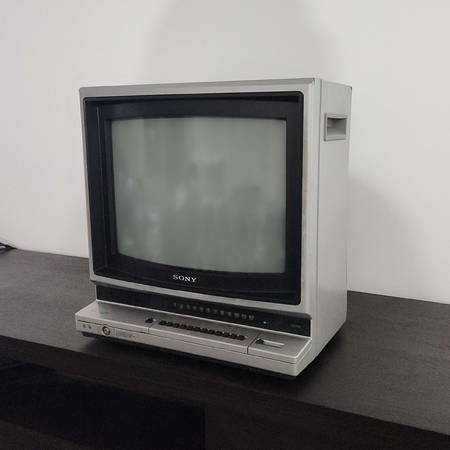
Sony KV-16D1
The Sony KV-16D1 is a 16" CRT television released to the Japanese market in 1983. It was a new addition to the Sony PRISM lineup, retailing for ¥89,800.
Design and Features
Like the other PRISM Trinitrons, the KV-16D1 is an RF-only television. It's built in a light grey colored plastic cabinet with a unique front "multi-panel" design.
Between the KV-13D1 and the KV-18D1, KV-16D1 was presented as a 'middle-of-the-road' size to fill the niche of people who wanted a TV larger than 13" but smaller than 18".
Inputs and Connectivity
Video
Despite releasing a year later than the original PRISM televisions, the KV-16D1 remains an RF-only system. Unlike the KV-13D1, the KV-16D1 has separated UHF and VHF inputs, using dual-screw terminals for the VHF, and the familiar F-type connector for UHF.
Another feature which was unique to the 16" PRISM televisions was the front panel 'Hit' connector. The 'Hit' connector was a defining feature for the KV-16D1 and KV-16DS1; branded as the 'worlds-first'[1] and was a popular idea for allowing users to easily and quickly swap between video sources like home computers and video game consoles.
Audio
The audio capability of the KV-16D1 is typical for a 1983 Trinitron television. It featured a single mono 2 watt speaker, and two 3.5mm TS mono headphone audio outputs on the front.
Controls
On the front of the television, there are three panels that can be flipped up to access various controls for the television.
- Left Panel:
Features the Trinitron logo, and some printed graphics indicating the front TS headphone jacks.
Flipping it up reveals picture adjustment knobs for: hue, saturation, brightness, and picture. - Middle Panel:
Features 12 soft-push channel buttons on the surface. Removing the panel reveals VHF/UHF switches and tuning wheels for setting and fine-tuning to a channel for each button. - Right Panel:
Features the volume slider. Removing the panel exposes the volume slider potentiometer and a small portion of the bare PCB.
Above the panels there is a glossy black strip which includes the speaker grille, an illuminated channel number display, a 'Hit' activity LED, and the power button.
Gallery
-
![A snapshot from Sony's 1984 Product Catalog featuring the KV-14DR3 and KV-16DS1.[2]](/img/wiki/de854baec3ee2edc9404681557f6cc84c465252dc0a9e252dc4edfe4047c6ee7.webp) A snapshot from Sony's 1984 Product Catalog featuring the KV-14DR3 and KV-16DS1.[2]
A snapshot from Sony's 1984 Product Catalog featuring the KV-14DR3 and KV-16DS1.[2] -
![Photo of the KV-16D1 with a Bandai Intellevision plugged into the Hit connector.[1]](/img/wiki/912f2ef3171e410511c9908f89eac56132a3d018c6251da872a4e0eadd814d23.webp) Photo of the KV-16D1 with a Bandai Intellevision plugged into the Hit connector.[1]
Photo of the KV-16D1 with a Bandai Intellevision plugged into the Hit connector.[1] -
![Photo of the KV-16D1.[1]](/img/wiki/51dc53a113c8ab95f149d4ae1f492c620814732d9d633c049b4281ef6a682f21.webp) Photo of the KV-16D1.[1]
Photo of the KV-16D1.[1]