This page serves to outline the various ASIC revisions used in Genesis/Mega Drive consoles.
Yamaha FC1004
This ASIC was first introduced in the original Wondermega and would see use in the VA7 model 1, VA0 through VA1.8 and VA3 model 2s, and all handheld and CD combination consoles. It combines the 315-5313 VDP, 315-5433 I/O controller, and a slightly modified Yamaha YM3438 FM synthesizer chip. Sega produced several variants of this ASIC, which are largely pin-compatible with one another.
315-5487 and 315-5487-01
The first version of the FC1004, used in the Wondermega[1], VA7 model 1, and some US and Japanese VA0 model 2s. Notable for having a completely broken 50 Hz mode, and because of this, the 315-5487 and 315-5487-01 were never used in PAL consoles. If switched to 50 Hz, there will be no sound and a few games will even crash. The -01 version was manufactured by Fujitsu and is known to have reliability issues with the internal lead frame degrading. Graphical errors may occur with a Fujitsu part and use of the Sega CD with both a Sega CD and 32X connected.
315-5487-10 (FC1004-X)
A slightly revised version of the original 315-5487. It is functionally identical except that the 50 Hz mode was completely removed, making it strictly 60 Hz. This chip is only found in Japanese VA0 model 2 consoles.
315-5487•
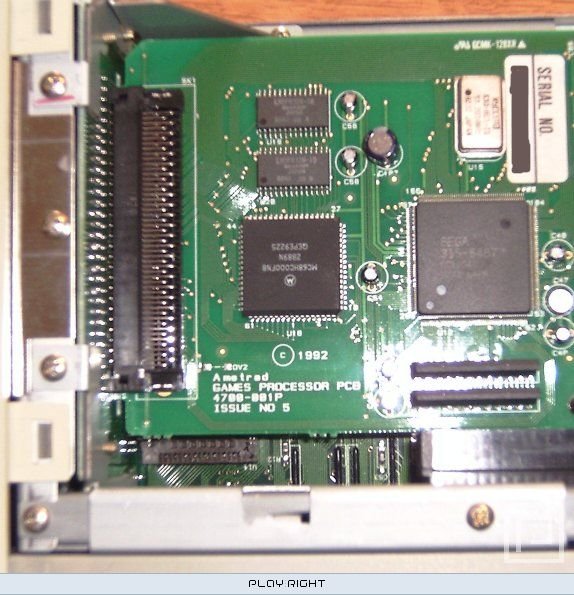
An extremely rare variant of the 5487 which fixed 50 Hz support while still remaining functional at 60 Hz. Only used in very early PAL Mega Drive IIs and the Amstrad Mega PC[2].
315-5660, 315-5660-01 and 315-5660-02
These ASICs are found in the vast majority of model 2 consoles, and are also used in the Wondermega M2[3], JVC X'Eye, Aiwa Mega CD, CDX/Multi-Mega, Pioneer PAC-S1/10, and some Brazilian VA7s [4]. All variants have a fully functional 50 Hz mode. The -01 version was manufactured by Fujitsu, and appears to be very rare. It may have reliability issues with the internal lead frame degrading like other Fujitsu chips. Graphical errors may occur with a Fujitsu part and use of the Sega CD with both a Sega CD and 32X connected.
315-5660-10 (FC1004-X)
A revised version of the 315-5487-10, mainly used in the VA1 Japanese Mega Drive 2 and the Mega Jet. Still has missing 50 Hz support, making it 60 Hz-only as with the 5487-10.
315-5700 (FF1004)
This ASIC was primarily used in the Genesis Nomad and some VA1.8 and VA3 model 2s. It is unknown what the differences are between this and other FC1004 variants.
-
 315-5700 in Model 2 VA1.8
315-5708-01
Same as the 315-5660 but manufactured by Fujitsu. It is known to have reliability issues with the internal lead frame degrading. Graphical errors may occur with a Fujitsu part and use of the Sega CD with both a Sega CD and 32X connected. This ASIC requires a 20 pF bypass capacitor on the /ASEL line and a 47 pF bypass capacitor on the /RAS0 line.[5]
Toshiba ASICs
During 1994, Sega also branched out to Toshiba to supply ASICs for model 2 Genesis production. These are notable in that they do not have an integrated YM3438 like the Yamaha ASICs, and consoles which used these chips instead featured a discrete YM2612 like most model 1s. As a result, the Toshiba ASICs have completely different pinouts and cannot be used in place of the FC1004 (and vice versa).
Despite only being used in North American consoles, both Toshiba ASICs can function properly at 50 Hz or in Japanese mode.
315-5685 (TC6158AF)
The first of the Toshiba ASICs. This is only found in later VA2.3 model 2s, which all have the model number MK-1631A. The 5685 has a broken shadow and highlight mode and glitched raster effects. More information on these can be found on this page.
315-5786 (T9N13BF)
A "fixed" version of the 315-5685. It is the only ASIC used in the VA2 model 2, and is also found in VA2.3 model 2s with the normal MK-1631 model number.
Yamaha GOACs
Yamaha FJ3002 (315-5960)
Introduced in the VA4 model 2, this is one of the first "Genesis On a Chip" (GOAC) ASICs. It combines the 68000, Z80, Z80 RAM, VDP, YM3438, I/O controller and bus arbiter into a single chip, greatly reducing production costs. It was also used in the VA1 Genesis 3.
Yamaha FQ8007 (315-6123) and G28007 (315-6123-01)
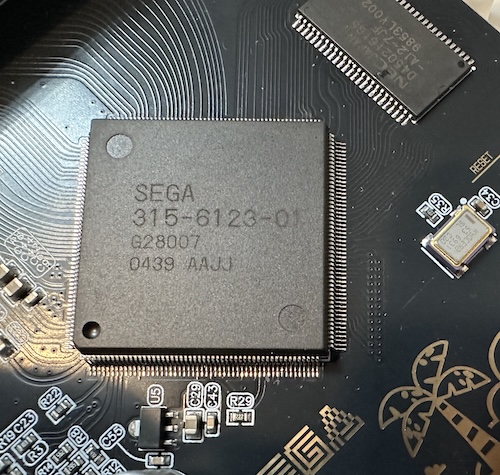
The second GOAC and final ASIC used in official Sega consoles. It completely strips out several features that were present on the 315-5960, such as the M3 pin for Sega Master System compatibility, horizontal and vertical sync outputs, and other signals which were mainly used by the Sega 32X. It can also use a single SDRAM chip for both the 68000 RAM and VRAM. In addition, the 6123 has signals that are specifically used by the Sega Pico, which is mostly based on Sega Genesis/Mega Drive hardware.
The 6123 was mainly used in the VA2 Genesis 3, some later Brazilian Mega Drive III consoles, and later Sega Pico Model 2 systems (Japanese HPC-0008 and HPC-0009, US MK49325).
The 6123-01[6] is a revision/die-shrink of the original 6123. It is unknown what is different. Only used in Sega Pico Model 2 systems (Japanese HPC-0008 and HPC-0009, US MK49325) produced after 2004, near the end of the Sega Pico lifespan[7].
References
- ↑ http://meulij.com/wondermega_disas.html
- ↑ https://media.playright.dk/screen/013/883/13632-amstrad-mega-pc@800x600min.jpg
- ↑ https://www.youtube.com/watch?v=4zcwOca2vSs
- ↑ https://www.reddit.com/r/SEGAGENESIS/comments/1fkrzwg/asic_yamaha_fc1004_questions/
- ↑ https://consolemods.org/wiki/images/9/9e/Sega_Genesis_Model_2_VA1_Service_Manual.pdf
- ↑ https://nicole.express/assets/img/2sega/315.jpeg
- ↑ https://nicole.express/2026/people-love-the-sega.html