This page serves as a reference for information on each model of the PlayStation 3. These are all objectively based recommendations, with no bias for the appearance of the console. Acronym definitions can be found on the FAQ page.
While this page mainly focuses on retail consoles (CECH), most characteristics of retail models will also apply to DECH (TEST) hardware and vice versa.
 | Many NOR consoles (CECHLxx to CECH-21xx) can come with Samsung K8Q2815UQB-PI4B NOR chips, which tend to have a higher chance to RSOD (however, this is usually still rare even with these chips). RSODs cannot be fixed unless you have CFW and/or replace the NOR flash chip. Consoles can also come with Spansion or (on Slim) Macronix NOR chips, which tend to be more reliable. |
PlayStation 3 "Fat/Phat" (2006-2009)
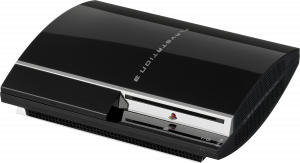
The original non-Slim versions of the PlayStation 3 can be distinguished by the large "PlayStation 3" branding on the top shell, entirely glossy finish, and the thicker/rounder shell.
The early versions of the PS3 feature hardware-based PS2 backward compatibility, four USB-A ports on the front, HDMI 1.3 output, memory card readers for SD, miniSD, Memory Stick PRO, and Compact Flash, chrome trim, the multi-AV port shared with the original PlayStation and PlayStation 2, Super Audio CD playback, and S/PDIF optical audio output. CECHBxx models had all black trim instead of chrome with no Wi-Fi connectivity and memory card readers, but are otherwise the same. These unique characteristics make it easy to identify a PS3 with PS2 hardware, in addition to them having much more case airflow.
Later versions of the PS3 removed two USB ports, the memory card readers, SA-CD support, and PS2 hardware. The chrome trim was also changed to a matte silver finish, but the rest of the I/O is the same.
Since it's the oldest version of the PS3, they tend to have the highest power consumption compared to the Slim and Super Slim revisions, especially when comparing the early models with PS2 hardware. Some early models which were sent into Sony repair centers may have a 65 nm or 40 nm RSX.
All fat PS3s have a daughterboard for the Blu-ray disc drive paired to the motherboard, but new daughterboards can easily be paired with FSM in custom firmware.
Retail PS2 Compatible SKU Comparison (A/B-Chassis)
| All models with a 90 nm RSX have a very high YLOD risk; proceed with caution if you commit to buying one. |
| Model | Description | CPU | GPU | Default HDD Size | Flash | Motherboard | MinVerChk |
|---|---|---|---|---|---|---|---|
| CECHAxx | First PS3 console released. Features full hardware-based PS2 backwards compatibility (EE+GS CPU/GPU and RAM) alongside four USB ports, two 128MB NAND flash chips, multiple card-reader ports, and the ability to play SA-CDs. Released in the U.S., Canada, and East Asia. | 90 nm CXD2964 | 90 nm CXD2971 | 60GB | 2x128 MB NAND | COK-001 | 1.00 |
| CECHBxx | "Lower-end" version of the CECHAxx. Came with a 20GB HDD, no card readers, and no Wi-Fi. Unlike other first gen fat models, this model replaced the glossy chrome trim with a glossy black finish. This model was also only released in the U.S., Canada, and East Asia. | 20GB | |||||
| CECHCxx | Uses the B-Chassis. First console to have some PS2 hardware for backwards compatibility (Emotion Engine CPU and RAMBUS) removed and instead have these functions emulated by the PS3's CELL CPU. Only the PS2's Graphics Synthesizer remains. It was also the first PS3 to be released in Europe and Oceania, but wasn't released in North/South America or Asia. PSUs in these models only operate at 220V-240V unless replaced. | 60GB | COK-002 | ||||
| CECHExx | Similar to the CECHCxx, but with an upgraded HDD. First PS3 to be released in South Korea and Latin America, and replaced the CECHAxx in all NTSC regions except for Japan, as Japan kept CECHAxx/Bxx models longer than other regions. In some cases, the CECHExx might have a COK-002W motherboard, indicating that it has been refurbished. | 80GB | COK-002 or COK-002W | 1.00 / 2.70 / 3.40 |
Retail Non-PS2 Compatible SKU Comparison (C/D-Chassis)
| All models with a 90 nm RSX have a very high YLOD risk; proceed with caution if you commit to buying one. |
| Model | Description | CPU | GPU | Default HDD Size | Flash | Motherboard | MinVerChk |
|---|---|---|---|---|---|---|---|
| CECHGxx | Switched to the new C-Chassis. First console to have the PS2 backwards compatibility chips completely removed, as well as two USB ports, the card reader ports, and the ability to play SA-CDs. The cooling system was also redesigned to be much cheaper, and the case has less airflow. The glossy chrome trim on this model and all future fat PS3s was also changed to a matte silver finish. Due to the 90 nm RSX having flawed underfill chemistry and the removal of front intake vents, this model is very likely to suffer from GPU failure unless it is replaced with a 65 nm or 40 nm RSX from a later fat or Slim. First PS3 to be released globally. PSUs of this console sold in PAL countries are only 220V-240V unless replaced. | 65 nm
CXD2981 |
90 nm CXD2971 | 40GB | 2x128 MB NAND | SEM-001 | 1.90 / 1.97 / 2.30 |
| CECHHxx | Switched to the new D-Chassis. First console to use a 16MB NOR flash instead of two 128MB NAND flash chips. Console's components and chassis were redesigned to not be compatible with previous models, but are cross compatible with the CECHJxx/Kxx/M03/Q00 models. Cooling system was even more drastically simplified to just two small heat sinks for the CPU and GPU respectively. PSUs found in European and Australian CECHHxx PS3s were also switched to universal voltage instead of only 220V-240V like in CECHCxx/Gxx consoles. Since these have the same RSX as the CECHGxx, CECHHxx consoles also have a high YLOD risk, in fact it is even higher than the CECHGxx due to having even worse heatsinks. | 16 MB NOR | DIA-001 | 1.97 / 2.30 | |||
| CECHM03 | Similar to CECHHxx, but only released in the UK & Ireland. The existence of this system is peculiar, as it released after the CECHLxx but uses the older DIA-001 motherboard with the same D-Chassis. Some users have speculated it comes with a VER-001, but this is not confirmed. | 80GB | |||||
| CECHQ00 | Similar to CECHHxx/M03, but only released in Japan with a larger HDD. Included in the Final Fantasy VII Advent Children limited edition console bundle. | 160GB |
Retail Non-PS2 Compatible SKU Comparison (E/F-
| Model | Description | CPU | GPU | Default HDD Size | Flash | Motherboard | MinVerChk |
|---|---|---|---|---|---|---|---|
| CECHJ02/03/04 | Switched to the E-Chassis. First console to feature a 65 nm RSX. Only released in Europe, Oceania, the United Kingdom, and Ireland. | 65 nm
CXD2989 |
65 nm CXD2982 | 40GB | 16 MB NOR | DIA-002 | 2.30 |
| CECHKxx | Same as CECHJ02/J03/J04, but with an 80GB hard drive and released worldwide. | 80GB | 2.16 / 2.30 | ||||
| CECHLxx | Switched to the F-Chassis, but is still compatible with parts from the previous chassis. 65 nm GPU received a new revision, and the motherboard design was slightly changed to have the USB ports and Wi-Fi chipset integrated onto the PCB, just like the "Slim" motherboards. Some of these models also came with cheaper aluminum CPU/GPU heatsinks compared to DIA-002 models. | 65 nm
CXD2990 |
65 nm CXD2991 | VER-001 | 2.30 / 2.45 | ||
| CECHPxx | Same as CECHLxx, but with a larger capacity hard drive. North American units were bundled with Uncharted: Drake's Fortune, and European units were bundled with four PSN titles. | 160GB | 2.45 |
PlayStation 3 "Slim" (2009-2012)
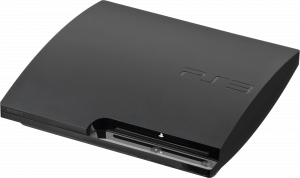
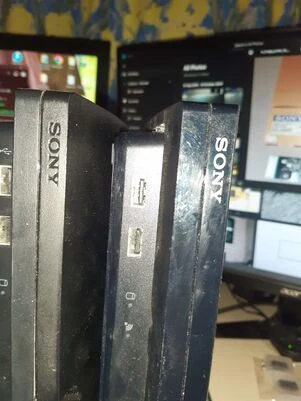
As an effort to drastically rebrand the PlayStation 3, Sony released a redesigned version of the PlayStation 3 (nicknamed by the community as the "Slim" version) in 2009. It is significantly redesigned compared to the original models while being slimmer, but the length of the console was increased. It can be identified by its sleek appearance, more minimalist "PS3" branding on the top of the shell, and the shell having a matte finish. CECH-30xx Slims can also be identified by an embossed Sony logo on the front of the system, whereas all the 20xx-25xx Slims had a printed logo. Introduces multiple variants of consoles, distinguished by "A" or "B" in the model number and different hard drive sizes.
The CECH-20xx models of the Slim featured a die shrunken 45 nm CELL, whereas the RSX was shrunken to 40 nm on the CECH-21xx models. Naturally, the cooling system was redesigned from the original PS3 to be cheaper to produce. This was the first PS3 that supported HDMI-CEC, which continued to be a feature in Super Slims and all future PlayStation consoles. This model was also the first to remove official OtherOS support, even with OFW older than 3.21. However, OtherOS can be still restored with various CFWs using OtherOS++.
CECH-20xx/21xx models have a daughterboard for the Blu-ray disc drive paired to the motherboard, but new daughterboards can easily be paired with FSM in custom firmware. The CECH-25xx/30xx models integrate the daughterboard hardware, mainly the drive controller, in the motherboard instead, thus swapping the Blu-ray drive on the CECH-25xx/30xx models is a bit easier due to not needing to account for remarrying or swapping its daughterboard.
Important note for custom firmware on CECH-25xx models: Consoles made between April and June 2011 (1B date code) are known to have an updated hardware encryption key (metldr2) and a MinVerChk of 3.60 official firmware, and therefore can't use CFW. A quick way to check if the console is exploitable is by looking at the manufacturing date if it's before April 2011 (North/South American consoles) or the date code for a 9, 0 or 1A (European/Australian consoles) on the bottom sticker. This method will not work on Asian region consoles (such as ones for Japan or Hong Kong) , as they don't show the manufacturing date in either format.
IMPORTANT NOTE TO CECH-30XX & 1B CECH-25XX: These models are not natively compatible with CFW, and getting that requires doing the BadWDSD hardmod, which requires soldering a modchip onto the board, and can be done on all 25xx/30xx models. The recommended method on those if you can’t do BadWDSD for whatever reason is to use PS3HEN, which allows for running game backups alongside most homebrew.
Consoles made between January and March 2011 (1A date code) usually can't be downgraded to 3.55 official firmware, but they can still use CFW with a noFSM patch, as they still have the old encryption key. The consoles that fall into these date ranges can be patched to install CFW. For consoles made during or after this date, you can check if it is patchable by running MinVerChk or Bgtoolset on the console to ensure it reports 3.56 or below official firmware, If it doesn’t, you can alternatively install PS3:BadWDSD on it (Note that this is a hardmod, therefore requires soldering)
Retail SKU Comparison
| Model | Description | CPU | GPU | Default HDD Size | Flash | Motherboard | MinVerChk |
|---|---|---|---|---|---|---|---|
| CECH-20xx | Slim launch model. Uses the G-Chassis. It's the first console to feature a 45 nm CPU; the NEC/TOKIN capacitors used for the CPU were replaced with standard tantalum capacitors. | 45 nm CXD2992 | 65 nm CXD2991 | 120GB(A) or 250GB(B) | 16 MB NOR | DYN-001 | 2.70 |
| CECH-21xx | Second model of Slims released; minor revision of 20xx. Uses the H-Chassis, but is still inter-compatible with 20XX parts. First console to feature a 40 nm RSX and replaced the NEC/TOKIN capacitors for the GPU with standard tantalum capacitors. The 40 nm RSX on this model and all future Slims have much stronger thermal plaster on the VRAM modules; thus, delidding them is much more difficult. The power supply was changed to be lower wattage, as the new RSX doesn't need as much power. The case was also changed slightly. Intriguingly, the YLOD sequence was slightly altered to not have a yellow light flash during the sequence, but will still show the flashing red light and play a triple beep sound. | 40 nm CXD5300 | SUR-001 | 3.20 / 3.40 | |||
| CECH-25xx | Third model of Slims released. Uses the J-Chassis, and its parts can't be reused on any other model. Last models to support the installation of CFW; read the note for more information. The Blu-ray disc drive controller is embedded in motherboard, reducing the possibility of needing No-BD firmware if the Blu-ray disc drive is defective. The shell was also changed, making older motherboards requiring slight modification to fit in shells from this model. The CXD2992BGB CELLs on this model use much more sealant and have black plastic spacers between the interposer and IHS, making CPU delidding on this model and the CECH-30xx model much harder than older models as a result. | 160GB(A) or 320GB(B) | JSD-001 or JTP-001 | 3.40 / 3.50 / 3.56 / 3.60 | |||
| CECH-30xx | Fourth model of slims released. Uses the K-Chassis. The shell, motherboard, Blu-ray drive, and power supply are exclusive to this model and cannot use parts from older model Slims. Does not support installation of CFW. Still has a plug-and-play Blu-ray disc drive like the CECH-25xx models. | 45 nm CXD2996 | 40 nm CXD5301 | KTE-001 | 3.60 / 3.65 / 3.66 / 3.72 / 4.10 |
PlayStation 3 "Super Slim" (2012-2016)
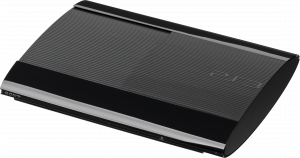
The PlayStation 3 "Super Slim" was the last style of the PS3 released. It can be distinguished from the other models by its unique two-tone matte and glossy finish on the top shell, with a ridged design on the matte part. It was further reduced in size from the original Slim, and the RSX no longer has an IHS.
Like the Slim series, its model number naming scheme uses a letter to indicate the system storage capacity, but with the letters A/B/C instead of just A/B. 4xxxB models came with a 250 GB HDD, and for the first time, 4xxxC models came with a 500 GB HDD, the largest official HDD size sold by Sony. This was the first PS3 that introduced internal eMMC storage on the 4xxxA models, and these eMMC models didn't come with a hard drive caddy, due to it being sold separately as the CECH-ZCD1. The eMMC itself was 16 GB, but 4 GB was reserved for the system, so only 12 GB was accessible to the user with advertising to reflect that.
Later in the Super Slim's production, Sony introduced a new RSX revision with a 28 nm process. It changed its VRAM configuration to be 2x128 MB instead of 4x64 MB chips. They do not appear to be much more efficient than the older Slim models. The 28 nm RSX also has a different pin-out than the 40 nm, making it incompatible with an original or Slim PS3.
The Blu-ray disc drive was redesigned to be a top loading drive like the PS1 and PS2 Slim, but with a sliding disc door. All Super Slim consoles lack a paired Blu-ray disc daughterboard, as the drive controller is integrated on the console's motherboard.
IMPORTANT NOTE TO SUPER SLIMS: This model isn’t natively compatible with CFW, and getting that requires doing the BadWDSD hardmod, which requires soldering a modchip onto the board, and can be done on all Super Slim models. The recommended method on those if you can’t do BadWDSD for whatever reason is to use PS3HEN, which allows for running game backups alongside most homebrew.
Retail SKU Comparison
| Model | Description | CPU | GPU | Default HDD Size | Flash | Motherboard | MinVerChk |
|---|---|---|---|---|---|---|---|
| CECH-40xxA/B | First Super Slim model. | 45 nm CXD2996 | 40 nm CXD5302 | None (A), or 250 GB HDD (B) | 16 GB eMMC (A), 16 MB NOR (B) | MSX-001 or MPX-001 | 4.10? / 4.20 / 4.22 / 4.25 |
| CECH-40xxC | Similar to CECH-40xxA/B series, but ships with 500 GB hard drives. Only comes with NPX-001 motherboards, which was the first to use the 28 nm RSX. | 28 nm D5305 | 500 GB HDD | 16 MB NOR | NPX-001 | ||
| CECH-42xx | Second Super Slim model. Motherboards in these models should also always have a 28 nm RSX. Curiously, PPX-001 motherboards changed the flex cable for the Blu-ray drive's laser pickup mechanism to be a 40 wire cable, like on all the CECH-43xx boards. | 45 nm CXD2996 (NPX-001)
45 nm CXD2999 (PPX/PQX-001) |
None (A), 250 GB HDD (B), or 500 GB HDD (C) | 16 GB eMMC (A), 16 MB NOR (B/C) | NPX-001, PPX-001 or PQX-001 | 4.40 / 4.45? | |
| CECH-43xx | Third Super Slim model. The last PS3 model to ever be released. Motherboards in these models always have a 28 nm RSX. | 45 nm CXD2999 | RTX-001 or REX-001 | 4.45? |
- You can also get Super Slims with a 40 nm RSX if you happen to get one with an MPX-001 or a MSX-001 motherboard.
Debugging Station (TEST)
PS3 consoles manufactured as a debug station (DECH) use very similar hardware compared to retail consoles (CECH), but differ in two key ways. The first difference is that they run a DEX signed operating system, which enables the Debug Settings. It allows for developers to both do debugging and sideload software developed with the PlayStation 3 SDK, in addition to having many other settings that aren't on the retail operating system.
The second major difference is that, intriguingly, they also come with a different HDMI encoder IC compared to an equivalent retail console. Their unique HDMI encoders allow for the always active HDCP protection to be disabled with the operating system's Debug Settings.
Reference Tool (TOOL)
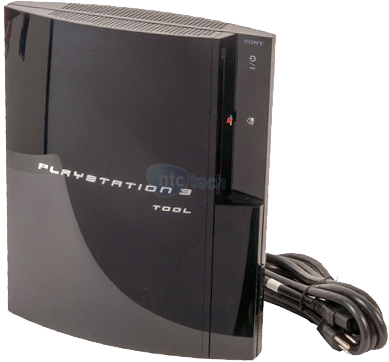
Differing greatly from the retail and Debug Station PlayStation 3s, the Reference Tools have vastly more features than the other two. These include direct kernel level debugging (extra GbE port), extra I/O compared to retail/testing kits, Blu-ray disc drive emulation, and doubled system RAM. Interestingly, they also don't officially support OtherOS or PS1/PS2 emulators on their stock firmware.
| Model | Description | CPU | GPU | Default HDD Size | Flash | Motherboard | MinVerChk |
|---|---|---|---|---|---|---|---|
| DECR-1000(A/J) | The original developer version of the PS3. It was first manufactured before the retail release of the PlayStation 3, and was used for game development. The Blu-ray disc drive is the same model from the finalized first generation fat consoles. Unlike all other models of the PS3, its case is in a large rack mount chassis. It features six total USB ports, memory card readers, four total LAN ports (with one used for remote debugging), and a serial port unlike CECH/DECH hardware. It also doesn't feature any PS1 or PS2 backwards compatibility in the official firmware, but can be regained with custom firmware. This and the DECR-1400 also feature double the system RAM (512 MB instead of 256 MB). | 90 nm CXD2964(?) | 90 nm CXD2971 | 400GB (GameOS)
400GB (BD Emulation) |
2x256 MB NAND | TMU-520 | <=0.80.004, 160.008, or 230.001 |
| DECR-1400(A/J) | The DECR-1400 was the successor to the DECR-1000, and was vastly simplified compared to its predecessor. It also features 512 MB of system RAM with an extra LAN port for remote debugging. It has the same appearance as a CECHBxx console (including four USB ports but without any card readers), but the motherboard components and Blu-ray disc Drive share more in common with the VER-001 consoles. The power supply is also the same model used in the CECHGxx, while the bootloader is similar to the CECH-20xx Slims. | 65 nm CXD2990(?) | 65 nm CXD2991 | 160GB | 16 MB NOR | DEB-001 | 260.001 |
Region Codes
The PlayStation 3 was released in several regions, with the last two digits of the model number (XX) indicating the region code. Asian region PlayStations will come with the X and O buttons switched in the XMB (X is cancel, O is confirm) but this can only be changed in CFW on CECH-25xx and earlier models.
More information can be found on the Region Information page.
Tips
- Always change the thermal paste when you buy a new console. This will ensure the longevity of the console and also make it quieter during use.
- If you get a console with a 90 nm RSX, it's recommended to install CFW and install webMAN MOD. webMAN allows you to modify the fan speed of the console which will also strongly contribute to increasing the maximum lifespan of it. On consoles with a 90 nm RSX (first generation consoles, non-refurbished SEM-001/DIA-001 consoles, and DECR-1000 developer kits), a recommended setting is to set the temperature target to 68°C or below, which is luckily set by default when webMAN MOD is first installed.