There are two SNES models, and a variety of revisions within these models.
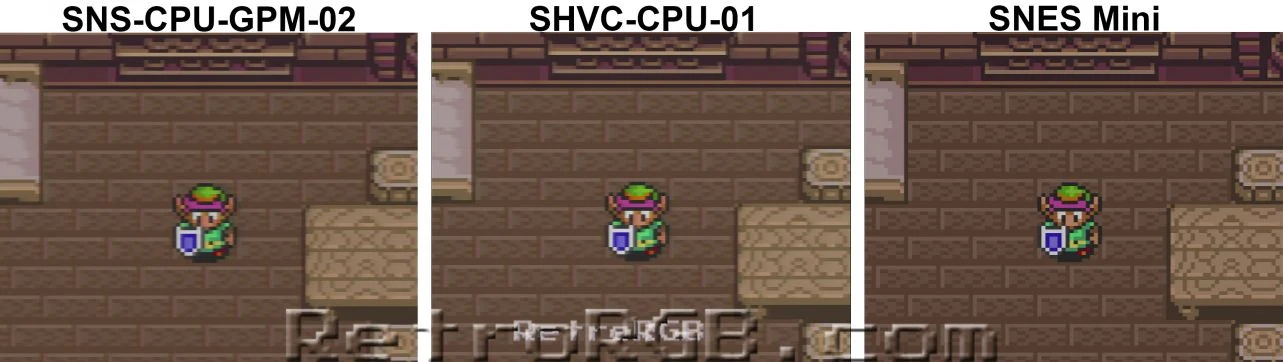
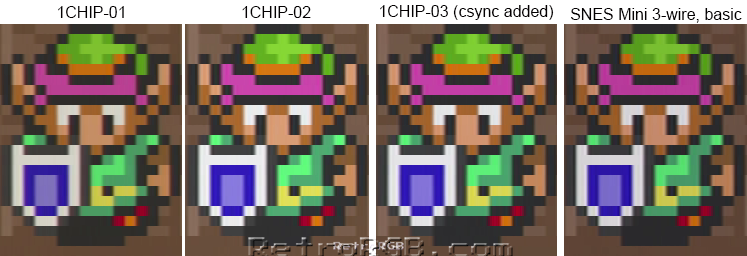
While there is only one board revision of the SNS-101/SHVC-101, the original Super Nintendo and Super Famicom consoles had many different motherboard revisions and chip changes. Most of the original SNES revisions used two PPU chips to produce a video signal and a CPU for general purpose processing, and these are usually referred to in the community as "2-chip or "3-chip" revisions. Beginning in 1995, Nintendo introduced consoles which combined the two PPUs and the CPU on a single IC (S-CPUN) to reduce production costs. Nintendo appropriately labeled these motherboard revisions "1CHIP". Three total revisions of these consoles were manufactured, the SNS-CPU-1CHIP-01, SNS-CPU-1CHIP-02 and SNS-CPU-1CHIP-03, which are detailed below. The SNES Mini / SNES Jr uses the same S-CPUN chip and produces an equal or better picture as the 1CHIP models, with the exception of some minor issues with certain games.
Models are arranged chronologically. Revisions are underneath their respective model.
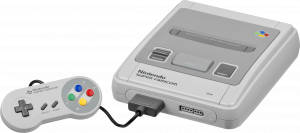
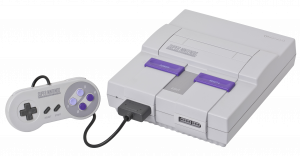
Super Nintendo Entertainment System / Super Famicom (SNS-001, SNSP-001, SHVC-001) (1990-1997)
 |
 |
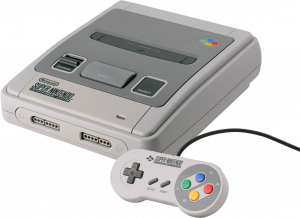 |
Japanese, Korean and PAL consoles use the same physical design, whereas North American and Brazilian consoles use a unique squared-off design with distinctive purple power and reset switches. All NTSC consoles (Japan, Korea and North America) share the same board revisions and hence are internally identical save for minor differences, such as the rear panel; Super Famicom consoles use the same 5.5 x 2.1 mm power jack as the original Famicom, whereas North American and Korean consoles used a unique power jack with an inner pin on the cable end, preventing users from accidentally inserting an NES AC adapter which could damage the SNES.
PAL consoles are largely identical to each other and were not divided into two incompatible regions as with the NES. Consoles sold in the United Kingdom and Hong Kong have an RF modulator using the PAL-I standard while all other PAL consoles use a PAL-G modulator. French SNES consoles have no RF modulator and only feature the AV multiout. All PAL consoles use the same AC adapter as the PAL NES, as they have a bridge rectifier to convert AC voltage to the DC voltage the console requires.
Distinguishing 001 revisions can be somewhat difficult without disassembly, except for distinguishing between a 3-chip and a 1CHIP.
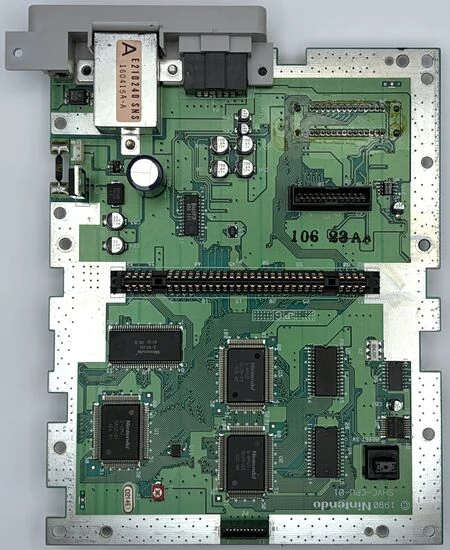
SHVC-CPU-01 (NTSC, 1990-1992)
 |
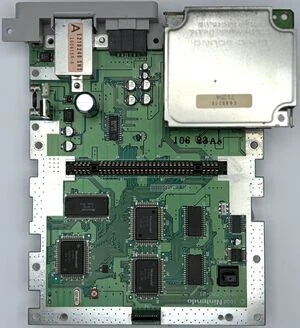 |
This is the original board revision for NTSC consoles, and is physically larger than any other NTSC revision. It is also the only board revision in any region to have a detachable sound module, which contains practically all of the audio hardware (S-SMP, S-DSP, sound RAM, DAC and amplifier). These have slightly better video quality than most 3-chip systems, but are prone to CPU/PPU faults and malfunctions[1], at a rate which is worsening over time. These are also more susceptible to having leaky SMD capacitors. Early consoles with the first revision CPU and PPU2 (5A22-01 and 5C78-01 respectively) have lower IC failure rates but are not necessarily immune to these problems. Later SHVC-CPU-01 boards found in US consoles omitted the 1000 uF filter capacitor at C67, a change that would extend to all future US SNES consoles.
Consoles with these boards also have four rubber feet on the bottom case, and bottom cases meant for these revisions will not fit later revisions (and vice versa). US consoles with an SHVC-CPU-01 board will also have a silver serial number label towards the front of the console.
SNS-CPU-GPM-01/02 (NTSC, 1992-1994)
 |
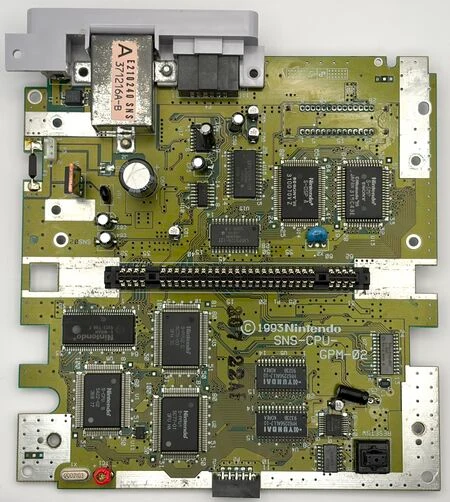 |
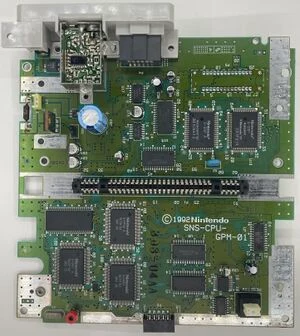
Introduced in late 1992, the GPM-01 (GPM standing for Ground Plane Method, a manufacturing process that eliminated the need for bottom RF shielding[2]) reduced production costs by having all of the sound hardware integrated onto the motherboard. The board itself is also significantly smaller in size compared to the SHVC-CPU-01. In addition, the lockout chip now gets its clock signal from the S-DSP chip instead of a discrete 4 MHz resonator. The GPM-02 revision, introduced in 1993, is largely identical and was also the last revision to have a removable cartridge port, though later GPM-02s have it soldered to the board.
Video quality on the GPMs is slightly degraded compared to the SHVC-CPU-01, as the video encoder was relocated towards the front and the video trace routing was heavily altered with this change. Both boards are less likely to have CPU or PPU faults. US SNES and Super Famicom consoles with these board revisions and later have a bottom case with only two rubber feet at the front. Starting with these revisions, Nintendo began omitting the cartridge lock mechanism on US consoles and added a gray warning label near the power switch.
Starting with the GPM-02, Nintendo opted to replace the Schottky Diode meant for polarity protection with a 0 ohm jumper. Due to the unique barrel jack used by North American consoles, this was likely a cost-cutting measure as no one at the time would be able to use a PSU with the wrong polarity. However today, this isn't always the case if you use a pigtail adapter with a more common power supply. To restore reverse polarity protection, simply remove the 0 ohm resistor and replace it with a SOT-89 Schottky Diode.
SNSM-CPU-GPM-02 (Brazil, 1993-1995)
Early Brazilian SNES consoles contain a slightly altered version of the SNS-CPU-GPM-02 board which outputs PAL-M video, known as the SNSM-CPU-GPM-02.[3] It is largely identical to its NTSC equivalent and still runs at 60 Hz, but has a different clock crystal (21.45366 MHz vs. 21.4773 MHz for NTSC) and pin 19 of the video encoder is connected to GND, which enables the PAL color encoding mode.
SNSP-CPU-01/02 (PAL, 1992-1995)
 |
 |
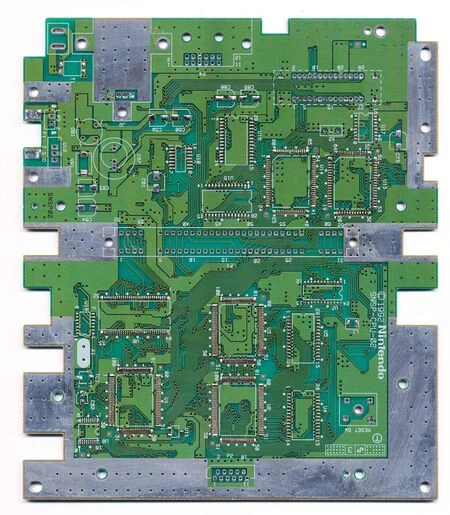 |
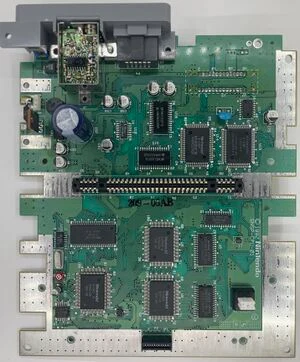
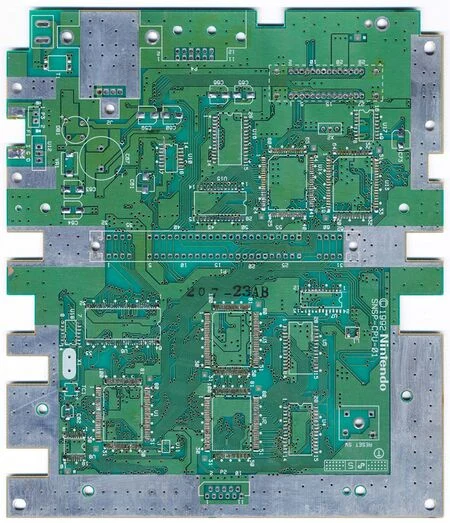
Both of these boards are the original board revisions for PAL consoles. They are similar to the GPM revisions in that all the sound hardware is integrated, but are physically the same size as the SHVC-CPU-01. They mainly differ from NTSC boards in that the power circuitry has been altered to accept an AC power supply, similar to the NES. In addition, Nintendo also added a voltage doubler to provide 12V DC on the AV multiout for SCART autoswitching. This function only works when an AC power supply is used, as a 9V DC supply rather than AC will only provide about 7.5V on this pin, not enough to trigger 4:3 mode on TVs with a SCART input.
The -01 revision and some -02 revisions have a polarized capacitor at C59, which is highly prone to failure. Most -02 revisions replaced this with a bipolar capacitor resolving this issue. In addition, the -02 has an extra via at C67 to accommodate a main filter capacitor with a smaller lead spacing. Aside from this minor layout change, the -01 and -02 are practically identical.
SNS-CPU-RGB-01/02 (NTSC, 1994-1995)
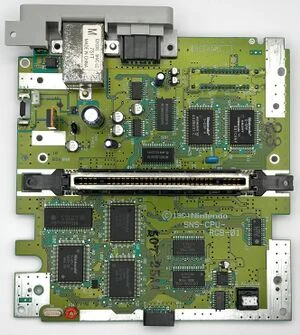
Somewhat identical to the GPM revisions, but the cartridge port is now soldered to the motherboard instead of being removable as on earlier boards. The most significant change is the S-RGB video encoder chip (ROHM BA6596F), which now amplifies the RGB signals instead of having them going through a discrete amplifier circuit. On the RGB-02 revision, Nintendo began using a different DAC (digital to analog converter) in the audio circuit, which resolved a minor audio balance issue present in earlier boards. Both boards have noisy RGB and S-video output due to a poorly routed color subcarrier trace. Severing or rewiring the subcarrier trace (which can be accomplished by lifting pin 3 on PPU2) tends to solve this issue, though severing it also means losing color via composite and the chroma signal.

Similar to the GPM-02, the RGB-01/02 lacks a Schottky Diode in US consoles, while they are present in Japanese systems. On the RGB-02 there is now a dedicated pad for the 0 ohm jumper, located on the bottom of the board at R28. On the top, there are pads for a Schottky Diode at D1 and a more common surface mount diode at D2. To restore reverse polarity protection, remove R28 and populate either D1 or D2 with their respective diode type. Note that you do not need to populate both pads; these were to accommodate for whichever diode type Nintendo's factory had on-hand.
SNS-CPU-APU-01 (NTSC, 1995-1996)
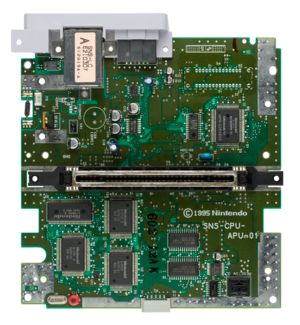
This is the final 3-chip revision, which has the S-SMP, S-DSP and sound RAM consolidated to a single chip, the S-APU. Nintendo also began using the S-MIX audio amplifier chip instead of an LM324. Video quality is noticeably degraded through S-video and RGB to a greater extent than the RGB-0x boards, though lifting the color subcarrier pin and pin 27 (pixel clock) on PPU2 can help reduce this interference.
For US consoles, some of the first UN30 serial numbers were assigned to these revisions, but these are usually associated with 1CHIP revisions. As with the RGB-01/02, US consoles lack reverse polarity protection. To restore this, remove R28 and populate D1 or D2 as mentioned above.
SNS-CPU-1CHIP-01/02/03 (NTSC, 1995-1997)
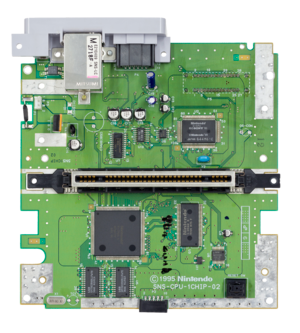
Introduced at the end of 1995, the 1CHIP-01 and its two subvariants are the final board revisions of the original model SNES/Super Famicom, which use the S-CPUN chip and have considerably sharper video compared to 3-chip revisions. These consoles do output slightly bright video with some ghosting, but these issues are easily fixed. However, they also have some game compatibility issues which cannot be corrected. US region motherboards once again lack polarity protection, having a 0 ohm jumper at R28 instead. These boards moved away from the Schottky Diode used previously in favor of the more common surface mount diode type. Restoring this protection can be done as listed above, removing R28 and populating D1.
Guaranteeing if a console is a 1CHIP requires opening it and looking on the motherboard for the term 1CHIP. However, one can read the serial number to increase one’s chances, as it appears that every US 1CHIP has a serial beginning with UN3. However, as mentioned above, not every UN3 is a 1CHIP console.
The -02 revision was introduced in 1996 while the -03 appeared in mid-1997. 1CHIP-01 and -02 revisions appear to be largely identical, but the -03 revision does not have the components for the composite sync signal populated. This may be an issue for those who use RGB cables which use the composite sync signal on pin 3 instead of composite video or luma for sync. However, composite sync can be restored on the -03 by adding back in the necessary components or adding a wire from pin 18 (composite sync output) of the S-RGB chip to pin 3 of the multiout.
SNSM-CPU-1CHIP-01/02/03 (Brazil, 1996-1997)
Brazil also received a version of the 1CHIP, though slightly altered to output PAL-M video instead of NTSC by the use of a different clock crystal and leaving the S-RGB encoder in PAL mode.[4] The -03 variant is also missing the components for composite sync output like its NTSC counterpart.[5]
SNSP-CPU-1CHIP-01/02 (PAL, 1995-1997)
 |
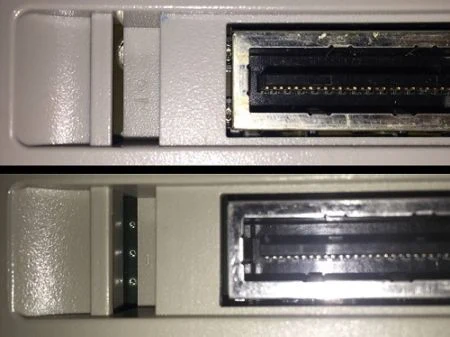 |
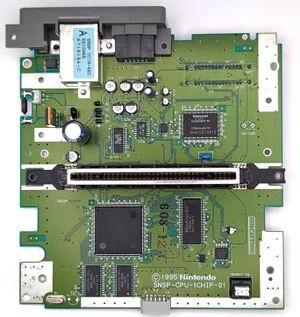
The PAL versions of the 1CHIP consoles. They are mostly similar to their NTSC equivalents, but still use an AC power supply and have a 12V voltage doubler circuit for SCART autoswitching. To reduce costs, Nintendo used a series of four diodes to convert the incoming AC voltage to DC instead of a bridge rectifier.
New-Style SNES and Super Famicom Jr. (SNS-101 / SHVC-101) (1997-2003)
 |
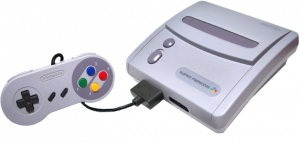 |
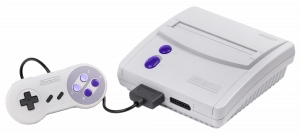
A highly cost-reduced and smaller redesign released during the late 1990s (1997 in North America, 1998 in Brazil and Japan). These models are smaller, rounder, and have a circular reset button with a circular power switch (both colored purple in North America and Brazil, and gray in Japan). However, the AV multiout does not support S-Video or crucially, RGB. There is also no eject button or an EXT port on the bottom for Satellaview support. Japanese and North American models also omit RF out, but the Brazilian model has RF out instead of the AV multiout. Because these use the same S-CPUN ASIC as 1CHIP consoles, these systems have better video quality than most SNS-001s and can be easily modded to restore S-video and RGB output. This also means they have the same compatibility issues. No PAL version of the New-Style SNES exists.
All SNS-101 and SHVC-101 consoles share the same board revision (SNN-CPU-01), which only had minor component differences between regions. Japanese consoles use the same power jack as the original Super Famicom and have an additional 2200 uF filter capacitor. Brazilian consoles, in addition to having an RF modulator instead of the AV multiout, output PAL-M video instead of NTSC.
Counterfeit New-Style SNES
Counterfeit SNS-101 consoles were produced from the late 1990s up until the early 2000s. They are rare, but they can be identified and have some notable differences from official Nintendo consoles.
Comparisons
3-Chip vs. Mini

3-Chip vs. 1CHIP vs. Mini
1CHIP vs. Mini
Links
- https://www.retrorgb.com/1chipsnes.html
- https://www.retrorgb.com/snes1chip.html
- https://www.retrorgb.com/1chipghosting.html
- https://www.retrorgb.com/snesversioncompare.html
- https://console5.com/techwiki/index.php?title=SNES
- https://en.wikipedia.org/wiki/New-Style_Super_NES
- https://gametrog.com/super-nintendo-snes-information-specs/
- https://en.wikipedia.org/wiki/Super_Nintendo_Entertainment_System (CPU bug info)
- https://ancientelectronics.wordpress.com/2014/08/19/the-best-version-of-super-nintendo/
References
- ↑ https://www.projectvb.com/nss/logs.htm
- ↑ https://consolemods.org/wiki/images/7/70/SNES_Service_Manual_%28Spanish%29.pdf
- ↑ https://snescentral.com/article.php?id=1017
- ↑ https://circuit-board.de/forum/index.php/Thread/27275-Super-Nintendo-Playtronic-PAL-M-Modell-Vorstellung/
- ↑ https://www.youtube.com/watch?v=akBv1FmW1Bg