Three models of the original Game Boy were produced, with the Game Boy Color only receiving one hardware version with a few motherboard variants.
Game Boy (DMG-001) (1989-1999)
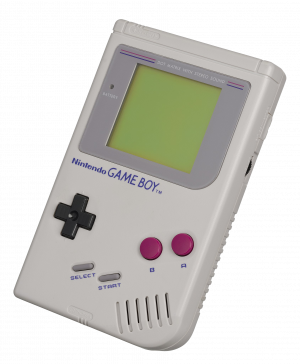
The original version of the Game Boy (nicknamed the "DMG"), first released during 1989 in Japan and North America, and 1990 elsewhere. It is the largest of all Game Boy models, featuring a green "pea soup" LCD screen and taking four AA batteries. On the left-hand side is the volume dial and DC power jack, with the headphone jack at the bottom and the contrast dial and link cable (EXT) port on the right-hand side. Next to the screen is a red power LED, which dims as the batteries run down. Battery life is the longest of all Game Boy models, lasting about two days when playing an original cartridge with the volume muted and not using accessories or modifications.[1] Despite this, the DMG has the lowest quality LCD of all Game Boys with fairly low reflectivity and significant motion blur. It is also the only Game Boy with a large link cable port, meaning it cannot connect to later Game Boy models or certain accessories (i.e. Game Boy Printer) without special cables or adapters.
Mainly due to its large internal volume and low quality LCD, the DMG has a very large modding scene and an equally large variety of modifications are available, ranging from simple DIY mods such as adding an audio line out, to professionally-made kits like backlit IPS screen replacements or rechargeable lithium battery packs with USB-C charging.
While the DMG had been supplanted in favor of the Game Boy Pocket by the end of 1996, it continued to be manufactured until at least 1999 for the European market.
Board Revisions
The DMG is made up of four PCBs, with the CPU and LCD/control boards being sandwiched together with an FFC cable connecting them in the middle, the DC-DC converter placed vertically on the left-hand side and the headphone jack having its own PCB at the bottom. About eight CPU board revisions for the DMG exist, with the DMG-CPU-01 through DMG-CPU-06 being largely identical. The CPU-07 and CPU-08 are cost-reduced boards, with the chip dies for the CPU and both RAM chips placed directly on the PCB and covered with epoxy blobs (known as "glop top" packaging). While this reduced production costs, it greatly hampers repairability compared to earlier boards as none of these chips can be replaced. Determining the board revision can be done without disassembly, as the version number is visible through the hole for the battery cover clip.
Several revisions of the LCD, power and headphone jack board were also produced, only featuring minor component or layout changes.
Color Schemes
At first, the DMG was only available in a single off-white color in all regions. By 1995, Nintendo began making the DMG available in multiple colors, most of which were available worldwide with two only being sold in certain regions. The original off-white DMG was discontinued. In North America, these were marketed as the "Play It Loud!" range while in Japan they were sold as the "Bros." range. The following colors were available:
- Black
- Blue (Europe only)
- Green
- Red
- Transparent
- White (Europe and Japan only)
- Yellow
A variety of limited edition DMGs were made as special contest prizes, though most of them are the original off-white system with company branding on the front.[2]
Game Boy Pocket (MGB-001) (1996-2000)
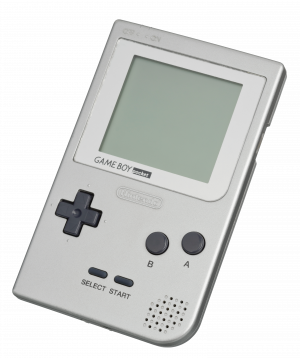
Nintendo replaced the original Game Boy during 1996 with the Game Boy Pocket (GBP), a complete redesign with a much smaller "pocketable" size. While no new hardware features were added, the GBP does have an improved LCD with a larger viewable area, increased reflectivity and a faster response time to reduce motion blur. However, to make the GBP's smaller size possible, Nintendo had to make several concessions with connectivity and battery capacity. Both the link cable port and power jacks are smaller than on the DMG, and the GBP takes two AAA batteries instead of four AAs. Because of this latter change, the GBP has the shortest battery life of all Game Boy models, lasting less than 10 hours. Complicating matters is that early GBPs omitted the power LED, making it difficult to determine if the batteries were about to run dry; Nintendo brought back the power LED in 1997. The GBP was discontinued in most markets by 1999, though it continued to be sold in Europe until at least 2000.
Board Revisions
The GBP has a great deal of internal consolidation compared to the original Game Boy, as the entire system is on a single PCB and the video RAM was integrated with the CPU. Two revisions for the original GBP exist, the MGB-CPU-01 and the MGB-ECPU-01. GBPs with the power LED have two revisions, the MGB-LCPU-01 and MGB-LCPU-02, which are mostly identical. These board revisions can be discerned without disassembly by looking under the left battery spring.
Color Schemes
A number of color schemes were available for the Game Boy Pocket upon its Japanese release, though outside Japan it was initially only available in silver. More colorways were added during the GBP's life. Colors that were available during its launch are in bold.
- Silver (early models without the power LED had a unique silver screen lens, later models with the LED had the same dark gray lens as other colors)
- Black
- Blue
- Clear Blue with ANA branding (Japan only, limited edition)
- Clear Light Blue (Japan only, only sold at Toys 'R Us)
- Clear Purple (Japan only)
- Emerald Green (Japan only, only sold at Toys 'R Us)
- Extreme Green (North America only, limited edition)
- Gold
- Green
- Ice Blue (North America only, limited edition)
- Off-White (Japan only, made to resemble the original Game Boy complete with a black D-pad, maroon action buttons and a light gray screen lens)
- Pink (Japan only)
- Red
- Transparent
- Yellow
A large of number of unique color variants were also available as contest prizes or giveaways, especially in Japan.[3]
Game Boy Light (MGB-101) (1998)
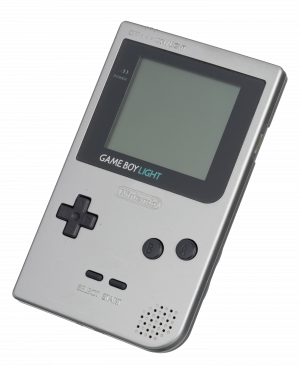
Released only in Japan in 1998, the Game Boy Light is the only original Game Boy model with a backlit screen. It is mostly based on the Game Boy Pocket, but is slightly larger and takes AA batteries, giving increased battery life over the GBP even with the backlight turned on. The B and A buttons also have their labels embossed into the buttons themselves instead of being silkscreened on the shell. Unlike other backlit handhelds of the era which used a fluorescent backlight, the Game Boy Light has an electroluminescent panel identical to the kind used in some wristwatches, with a soft cyan glow. It can be switched off for outdoor conditions and to save battery life.
The Game Boy Light was discontinued with the release of the Game Boy Color in late 1998 and is by far the rarest of all original Game Boy models.
Color Schemes
The Game Boy Light was mainly available in gold or silver color schemes, with a clear yellow color available only at Toys 'R Us stores and a handful of limited editions made as contest giveaways.
Game Boy Color (CGB-001) (1998-2003)
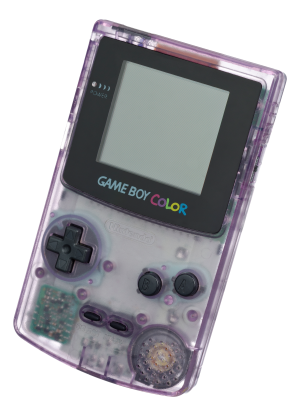
The Game Boy line received its first major hardware update with the release of the Game Boy Color (GBC) in late 1998, adding a full color TFT screen and increased system performance with a faster CPU and increased RAM. Connectivity is mostly the same as the Game Boy Pocket, using the same link cable port and power jack, but the GBC also adds an infrared transceiver at the top, which can send and receive data wirelessly with another GBC. Like the Game Boy Light, the GBC takes two AA batteries. Its battery life is second only to the original Game Boy, lasting more than 30 hours with the sound muted and without mods or accessories.
It is almost fully backwards compatible with the original Game Boy library, and the GBC can also "colorize" original Game Boy games with a user-selectable color palette (though certain games will load with their own special color palette). The GBC also has its own library, with some games being compatible on the original Game Boy and others that will only work on the GBC (or the later Game Boy Advance). Dual compatible games have a black cartridge shell and will display full color on a GBC, but do not use the faster CPU speed or extra memory. GBC-only games come in a clear shell and use the GBC's extended capabilities, making them totally incompatible with original Game Boy hardware.
Although the Game Boy Color was succeeded by the far more powerful Game Boy Advance in 2001, sales continued until 2003.[4]
Board Revisions
A few board revisions exist for the Game Boy Color, some of which have significant hardware bugs due to the CPUs used in these revisions[5]. As with all previous Game Boy systems, the revision can be determined without disassembly, this time by looking at the number visible under the left battery spring. An 02 will signify that it is a CGB-CPU-02, an 03 meaning a CPU-03, and so on. The original revision, the CGB-CPU-01, does not have this number under the battery spring.
CGB-CPU-01 to CGB-CPU-04 (1998-2000)
These revisions will have CPU revisions A through C, which have several issues with the audio registers, different audio input impedance compared to later revisions, and increased background noise. In rare circumstances, these CPUs can cause unpredictable behavior such as crashes or other glitches. BennVenn's ElCheapo SD v2.0 flash cart also has some issues on boards with these CPUs.
Some CPU-04s have the revision D CPU, which fixes many of these bugs. This can only be determined by disassembling the system and looking for a "D" on the CPU. The revision D CPU introduced a new bug. On all CPU revisions preceding CPU CGB D, resetting TILE_SEL on the same T-cycle as a bitplane data read will cause the tile index to be instead used as the data for that bitplane. On CPU CGB D, resetting TILE_SEL on the same T-cycle as the bitplane 1 data read will cause the PPU to instead read the bitplane data from the address for bitplane 0.[6]
CGB-CPU-05 (2000)
All of these boards will have the revision D CPU but are otherwise identical to previous revisions.
CGB-CPU-06 (2000-2003)
In this revision, all of the RAM is integrated with the CPU (revision E), leaving the audio amplifier and voltage regulator as the only other remaining ICs. The CPU CGB E also resolves the bug introduced in revision D. It is otherwise functionally identical to later CPU-04s and the CPU-05.
Color Schemes
Like the Game Boy Pocket, the GBC was available in a variety of color schemes and a very large number of limited edition systems were produced, most only available in Japan or through contests. Launch colors are listed below:
- Atomic Purple/Clear Purple
- Berry
- Dandelion
- Grape
- Kiwi
- Teal
- Transparent (Japan only)
Game Compatibility
As documented on gbdev wiki, a handful of Game Boy titles don't function correctly on later models.
Links
https://en.wikipedia.org/wiki/Game_Boy
https://www.retrorgb.com/gbversions.html
https://en.wikipedia.org/wiki/Game_Boy_Color
https://gametrog.com/nintendo-game-boy-information-specs/
References
- ↑ https://jonthysell.com/2023/06/09/nintendo-game-boy-battery-tests/
- ↑ https://gameboy.fandom.com/wiki/List_of_Game_Boy_System_Colors_and_Variations
- ↑ https://gameboy.fandom.com/wiki/List_of_Game_Boy_System_Colors_and_Variations
- ↑ https://web.archive.org/web/20161011145332/https://www.nintendo.co.jp/ir/library/historical_data/pdf/consolidated_sales_e1603.pdf
- ↑ https://bennvenn.myshopify.com/pages/gbc-cpu-revisions
- ↑ https://github.com/mattcurrie/mealybug-tearoom-tests/blob/master/the-comprehensive-game-boy-ppu-documentation.md