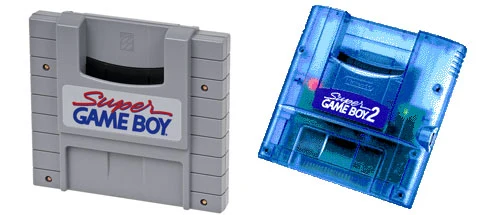
In 1994, Nintendo introduced an accessory for the Super Nintendo and Super Famicom known as the Super Game Boy, allowing consumers to play Game Boy games on a TV through a Super Nintendo or Super Famicom console. The SGB also includes special features such as adjustable color palettes, custom borders, and on certain Game Boy games unlocks special content. Two versions of the Super Game Boy were released, with the original being released worldwide and the Super Game Boy 2 only seeing a Japanese release in 1998. As both adapters predate the Game Boy Color and Game Boy Advance, GBC-only and GBA games are incompatible.
Model Differences
Both versions of the SGB are easily discerned by their different color shells; the original is the same color as a standard SNES or Super Famicom cartridge, while the SGB2 came in a clear blue shell. The US version of the SGB uses its own unique shell similar to the cartridges used in that region. Japanese and European SGBs look nearly identical, though neither are compatible on the other region console (i.e. a Japanese SGB will not work on a PAL SNES) due to their different lockout chips. Both the Japanese SGB and SGB2 will technically work on a US SNES, but are blocked by tabs inside that console's cartridge slot.
Aside from cosmetics, the SGB2 has a link cable port (the same type used on the Game Boy Pocket and Color), a red power LED and a green LED that lights up with link cable activity. Another crucial difference between the two is how they get their master clock signal. The original SGB derives its clock from the SNES itself (dividing the SNES's clock by 5) while the SGB2 uses its own clock crystal. On an NTSC console, this results in the original SGB running at about 4.295 MHz (4.295454 MHz to be exact), slightly faster than the Game Boy's proper clock speed of 4.194304 MHz. This causes issues such as a slightly higher audio pitch and a screen stutter that occurs every few frames. It is also the reason why the original SGB does not have a link cable port, as the clock speed mismatch between the SGB and a Game Boy would cause synchronization issues. By comparison, the SGB2 uses the same clock crystal as a Game Boy system, so games will run at their correct speed, the audio will be at the correct pitch and the screen stutter is eliminated.
Lastly, the SGB2 includes an additional set of custom borders while still retaining the first set from the original SGB. The different border sets can be switched by selecting the plain black border, exiting the main menu and pressing L four times followed by R once.
Below are video captures exhibiting some of the differences between the two models:
- Super Game Boy: https://www.retrorgb.com/assets/videos/SGB.mp4
- Super Game Boy 2: https://www.retrorgb.com/assets/SGB2.mp4
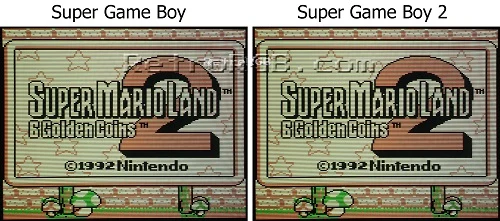
There is also a very slight difference in both models' default color palettes, illustrated below:
Screen Size
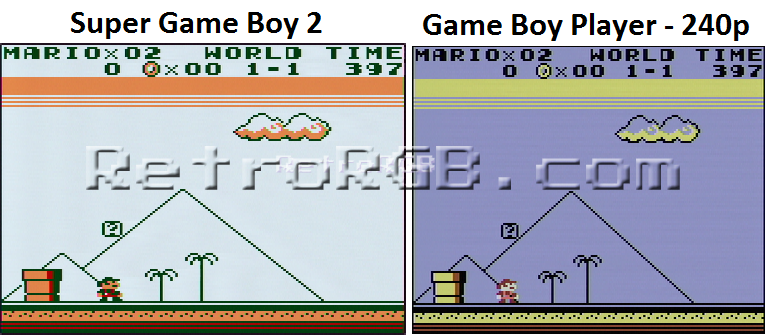
When using either version of the Super Game Boy, the original game resolution (160x144) is played in a "windowed" mode inside the 240p output of the SNES. There are selectable borders (or black bars) around the game screen and while the overall output signal is excellent, the SNES outputs the GB's video signal at a slightly wider aspect ratio than an actual Game Boy system. Here is a screenshot comparing its aspect ratio to the Game Boy Player's correct ratio:
Clock Speed Modification
The original Super Game Boy can be modified with a discrete clock crystal to run at the proper speed and can even be modified with a link cable port, making it functionally equivalent to an SGB2. Custom PCBs such as this made by qwertymodo exist which simplify this process.
Super Game Boy Enhanced Games
After the release of the Super Game Boy, a large number of Game Boy games and even some Game Boy Color games were released with a "Super Game Boy" mode, which introduces enhancements such as dynamic color palettes, additional sound effects generated from the SNES hardware, special borders, and more. See here for a list of enhanced games.
Super Game Boy Commander
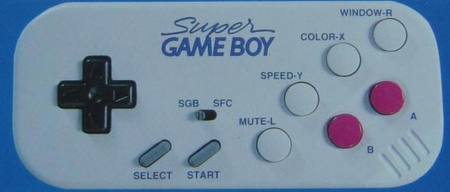
Accessory manufacturer Hori, who co-designed the Super Game Boy[1], released a special controller in Japan known as the SGB Commander, which mimics the form factor of an original Game Boy and was designed for use with the SGB. It includes two shortcut buttons for switching color palettes and opening the main menu, and two special buttons which mute the audio and even slow down the SGB. These last two features are not accessible without the SGB Commander as these buttons simulate an extremely rapid succession of shoulder button presses.[2] The SGB Commander also has a compatibility switch so it can be used as a standard Super Famicom controller.
Other TV-Out Options
Since the release of the Super Game Boy, there have been other options for playing Game Boy games on a TV:
Famicom Adapter
In recent years, special adapters for use on the Famicom have popped up in places such as Aliexpress. These adapters use CPUs salvaged from original Super Game Boy adapters, but run at the proper clock speed. Their feature set is limited compared to the SGB, only providing custom color palettes.
Wide-Boy64
This adapter was created by first-party developer Intelligent Systems and was designed for use on a Nintendo 64. Two versions of the Wide-Boy exist, one which plays both GB and GBC games[3], and a later model which also plays GBA games. However, these were only sold to developers and the gaming press, and were never made available to the general public in any capacity. As a result, they are very rare and sell for fairly high prices.
Retron 5
The Retron 5 console can play all Game Boy games, but it is an emulation-based console and also exhibits some significant control lag.