Only two models of the Sega CD (or Mega CD outside of the Americas) were ever produced, each with a radically different design but with the same functionality. Both models take the same tip negative 9V AC adapter as the model 1 Genesis/Mega Drive, and either model will work with either a model 1 or 2 console.
Model 1 (front-loading) (1991-1993)
 |
 |
 |
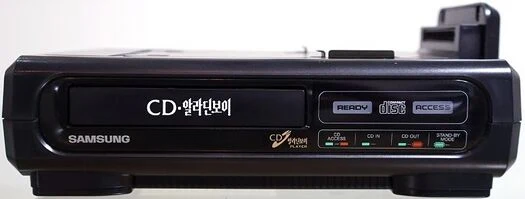 |
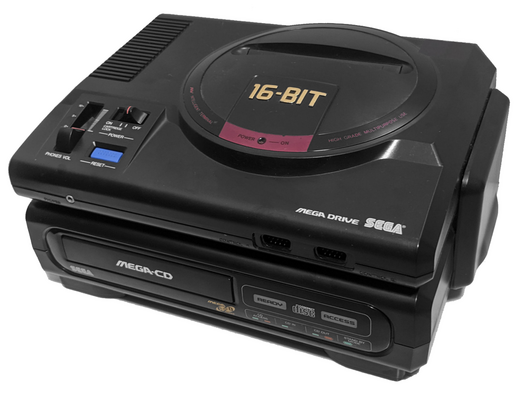
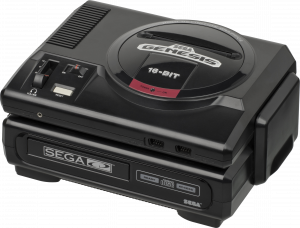
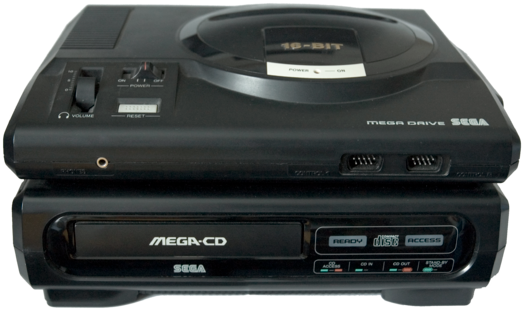
The initial model of the Sega/Mega CD, originally released in December 1991 in Japan, followed by North America in late 1992, and South Korea and PAL regions during the spring of 1993. It is easily distinguished by its front-loading CD tray and the fact that it sits directly underneath the Genesis/Mega Drive with the expansion connector protruding on the right-hand side. It is designed to specifically pair with a model 1 console, but can be used with a model 2 by removing the console's rubber feet (this is even mentioned in the model 2 manual). There are no controls on the add-on itself; the disc tray is opened by using the system menu or resetting the attached console, and is closed by using the system menu. Green "Ready" and red "Access" LEDs are on the front bezel while all connections (DC input, RCA audio out and 3.5 mm audio in) are grouped together at the rear. Japanese and PAL model 1s also have small diagrams on the front showing what the different LED light patterns mean.
All Japanese and most North American units have a drive mechanism manufactured by Sony while most PAL units have a drive made by JVC. Very early Mega CDs of this revision use an EPROM BIOS chip placed inside of a socket. This makes it easier to swap it out for a Region-Free BIOS or the BIOS of another region or version. These often have a serial number starting with A10.
Service Notes
Unfortunately, the model 1 is plagued with reliability issues such as bad tray belts, dirty limiter switches, faulty helix/Archimedes screws on Sony drives, and leaky capacitors. The main board in particular contains a number of SMD capacitors which must be replaced, even if there are no visible signs of leakage. Leaky capacitors can also be found on the "sub" board in the vicinity of the voltage regulator. Systems with a JVC-manufactured drive can also suffer from bad capacitors on the drive controller board.
-
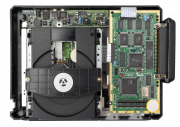 The inside of a model 1 Sega CD with a Sony CD drive.
 -
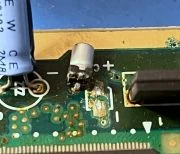 Capacitor leakage such as this inside a model 1 Japanese Mega CD is unfortunately rather common; this particular capacitor required very little force to remove due to the corroded solder joints.
Model 2 (top-loading) (1993-1995)
 |
 |
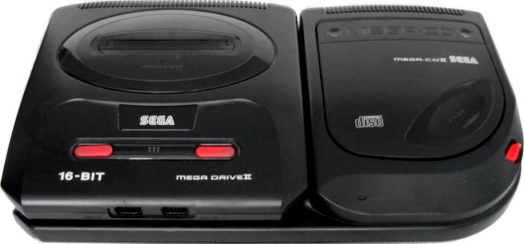 |
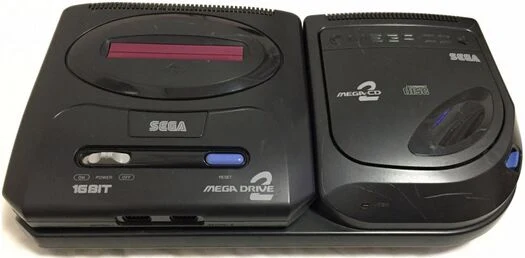
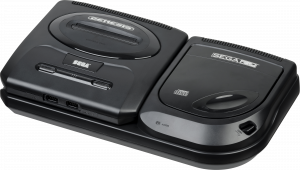
Introduced in early 1993 alongside the model 2 Genesis/Mega Drive, the model 2 Sega CD was a drastic redesign which did away with the front-loading tray in favor of an inexpensive top-loading design. This is perhaps the most common version of the Sega/Mega CD, especially outside Japan. It was also the only version of the Sega CD hardware to see a release in Brazil. The Genesis/Mega Drive sits on top of a thin base which houses the unit's motherboard while the drive mechanism sits to the side of the attached console. Although designed to match the model 2 console, a model 1 Genesis/Mega Drive can be used on the model 2 albeit with the console partially hanging off the side. Sega included an extension piece to provide full support when used with a model 1. A lone disc access LED is on the top front, while all the rear connections are exactly the same as on the model 1. The green "Ready" LED was omitted.
In terms of reliability, the model 2 CD is far more robust and does not have issues with leaky capacitors or tray issues considering its top loading nature. The most common fault with the model 2 is the fuse, which can be blown if the wrong AC adapter is used or if the Genesis/Mega Drive is attached or removed while the CD is still plugged into power. Thankfully this is easily repairable and can restore the add-on to working order again.
Board Revisions
Six board revisions of the model 2 CD exist, five designed and manufactured by Funai and one designed by Sega themselves. All except for the Sega board incorporate all of the CD processing and drive controller circuitry onto the motherboard, as well as the drive activity LED. For all regions, systems with a Sega board have an "A" at the end of the model number (ex. MK-4102A for North American units, HAA-2912A for Japanese units).
BE2200G02A01 (Funai)
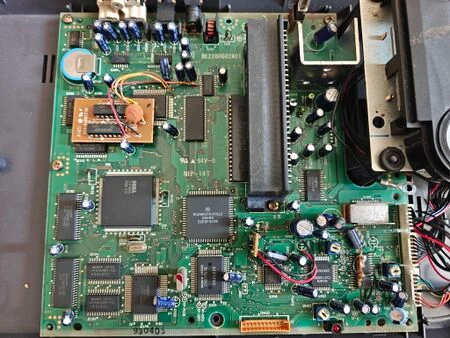
This is the earliest revision of the model 2 and is only found in Japanese Mega CD 2 units. It is easily discerned by a small "bodge" PCB glued directly on top of the 315-5476A PCM chip and its associated RAM. In addition, it is the only model 2 variant to use the 315-5548 Mega CD Engine (MCE2) ASIC, which is normally found in non-Japanese model 1s.
BE2200G02A02 (Funai)
The first board variant for North America, mainly found in early model 2s. While it uses the revised 315-5632 ASIC (MCE3), it still features the "bodge" PCB from before.
BE2200G02B02 (Funai)
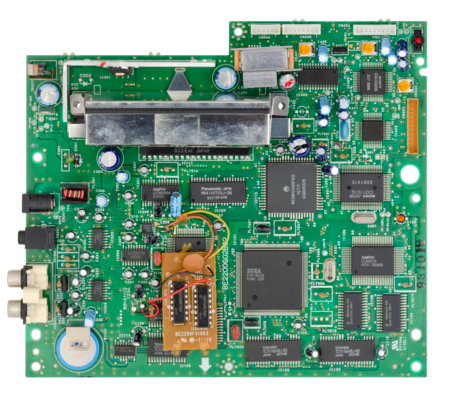
Similar to the 2A02 but with minor layout changes. This was the first revision for PAL region model 2s.
BE2200G02C02 (Funai)
Similar to the previous revision, but incorporates the contents of the "bodge" into the board. This board was introduced beginning with serial numbers T30282001 and later.[1]
171-6528C (Sega)
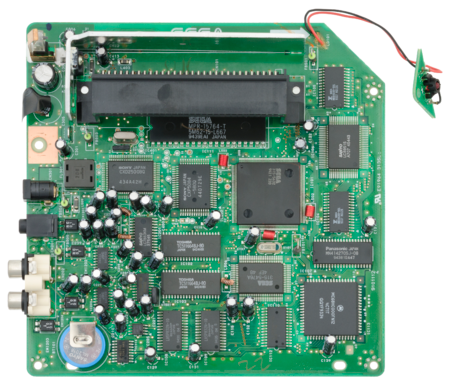
The only revision designed by Sega, this board is considerably smaller than most of the Funai boards as it offloads the drive controller circuitry onto a separate PCB mounted underneath the laser mechanism. The activity LED has also been placed on a separate board which is screwed onto the bottom case. BIOS ROMs meant for this revision are "universal" and will work in any model 2, but the BIOS included with earlier Funai boards is not compatible with Sega boards. The service manual refers to this as the "Sony" model, although systems with this board can also be found with a JVC laser (detailed below).
BE2200G02C22 (Funai)
This is the final board revision of the model 2 and features a considerable degree of consolidation, as the audio DACs and op-amps have been combined into a single chip known as the 315-5619. Despite this, its audio quality is not discernibly different from the original design. It is like other Funai boards in that the drive circuitry and activity LED are integrated with the board.
Lasers
Funai systems either have a Sony KSS-210A or Samsung SOH-O4T laser, whereas Sega boards can have either a JVC Optima-6 or Sony KSS-240A laser. For the latter, mechanisms with the Sony laser have a silver spindle while those with a JVC laser have a black spindle.
-
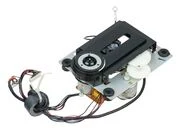 A drive mechanism from a model 2 with a Funai board. This particular mechanism has the Samsung SOH-OT4 laser.
 -
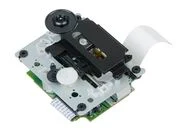 A drive mechanism from a model 2 with a Sega board. This particular mechanism has the JVC Optima-6 laser.
Links
https://en.wikipedia.org/wiki/Sega_CD
https://gametrog.com/sega-cd-model-1-2-information-specs/
https://gametrog.com/how-which-sega-cd-system-do-i-have/ (howto tips)
https://www.reddit.com/r/SEGAGENESIS/comments/8w7fpa/model_1_or_2_sega_cd/
https://gametrog.com/how-to-connect-hook-up-sega-cd-1-front-loader-to-genesis-model-2/ (M1 CD on M2 Genesis)
https://gametrog.com/how-to-connect-hook-up-sega-cd-2-clam-tray-loader-to-genesis-model-1/ (M2 CD on M1 Genesis)