There are two major variants of the SNES and Super Famicom, with the original model having a number of different revisions. This buying guide serves to delineate the differences between these revisions and briefly explain what to look for when adding an SNES or Super Famicom to your setup.
Original Model (SNS-001/SNSP-001/SHVC-001)
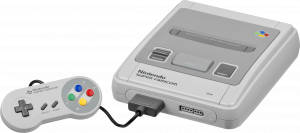 |
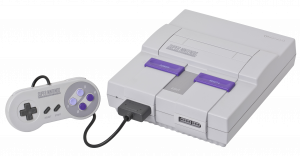 |
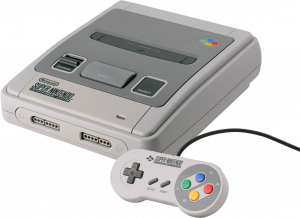 |
- Released in the following regions:
- Japan: November 1990
- North America: August 1991
- PAL regions: 1992
- South Korea: 1992
- Brazil: August 1993
- Has two major cosmetic designs, a rounded one which was used in Japan, Korea and PAL territories, and a more rectangular design used in North America and Brazil. The cartridge shapes also differ between regions and are not interchangeable without adapters or modding
- Outputs composite video, S-video, RGB and stereo audio from a custom 12-pin multiout connector
- All except French and Korean models also have RF output
- The power input jack differs between regions:
- Super Famicom consoles take a 5.5 x 2.1 mm barrel jack with tip negative polarity, power supply specifications are the same as the original Famicom (9V DC, 850 mA)
- US and Korean SNES consoles take a 6.9 x 4.1 mm barrel jack with a center pin and tip negative polarity. Specifications are 9V DC, 850 mA
- PAL SNES consoles take a 5.5 x 2.5 mm barrel jack, power supply specifications are the same as the PAL NES (9V AC, 1.3 A)
- Both NTSC and PAL consoles use different video cables:
- Composite on NTSC consoles is a passthrough cable, PAL consoles need a 75 ohm resistor inside the cable to attenuate the signal
- S-video on NTSC consoles is also a passthrough cable, PAL consoles need resistors inside the cable
- For RGB, NTSC consoles only need 220 uF capacitors for red, green and blue to filter out DC offset, while PAL consoles need 75 ohm pulldown resistors. In addition, PAL consoles have 12V DC where composite sync is on NTSC consoles. Because of this reason, do NOT use NTSC RGB cables that use composite sync on a PAL SNES, or damage to your display or upscaler will result. PAL consoles can use either composite video or luma for sync instead.
- Earlier US SNES consoles and all PAL and JP consoles have a cartridge lock mechanism designed to prevent cartridges being removed while the console is powered on
- Has an expansion port on the bottom which was largely unused. It was only used for the Satellaview accessory in Japan, and the extremely rare LifeCycle Exertainment exercise bike
- Older consoles are more susceptible to yellowing, which also causes the shell to become brittle. Newer consoles are more resistant but not immune to this. Replacement high quality shells are available from Retro Game Restore or places such as Aliexpress or eBay, but they are only available in transparent colorways with a smooth finish.
- All model 1 consoles are identical in functionality, though the 1CHIP models have significantly sharper video quality and are much more desirable as a result. However, the 1CHIP models have some caveats, such as game compatibility problems and flaws with their video output. If these compatibility issues do not concern you, the 1CHIP models are an otherwise great choice and their video issues can be fixed, giving them excellent video quality.
- Older model 1s before the 1CHIP have fairly blurry RGB, but various mods exist which can resolve this problem. This issue is also less apparent through composite video and S-video. If you want to be able to play every game without problems, these revisions are the ones to go for. In addition, since they are far more common and in less demand than the 1CHIPs, they can be had for significantly less.
- SHVC-CPU-01 through SNS-CPU-RGB-01 revisions have an audio balance issue due to sharing one capacitor tied to ground for both left and right voltage reference (Vref) pins on the DAC (digital to analog converter). Each pin is supposed to have its own capacitor in order to lower its impedance. This can be corrected with a slight modification.
- Avoid the original SHVC-CPU-01 revision if possible. See the special section on these below for more information.
- The later SNS-CPU-RGB-0x and SNS-CPU-APU-01 revisions have poor RGB and S-video output, but can be fixed
Board Revisions
Nintendo produced several revisions of the model 1, with each revision consolidating chips and/or circuitry to reduce production costs. Japanese, Korean and North American models share the same motherboard revisions, while Brazilian and PAL models received their own.
| Photo | Revision Name | Date Range | Regions | Notes |
|---|---|---|---|---|
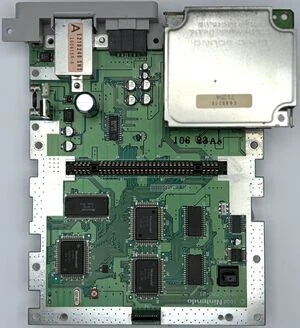 |
SHVC-CPU-01 | 1990-1992 | NTSC | Has a removable cartridge port and a separate plug-in module which contains the sound hardware. Is physically larger than all other NTSC board revisions. Highly susceptible to chip failure and leaky capacitors (see section below), but older units with the original revision CPU and PPUs (known as 1/1/1) tend to be more reliable. Has the highest quality stock video output of all 2-chip/3-chip consoles. |
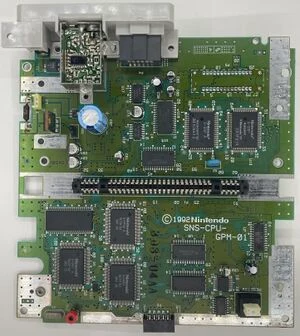 |
SNS-CPU-GPM-01 SNS-CPU-GPM-02 |
1992-1993 (GPM-01) 1993-1994 (GPM-02) |
NTSC | Incorporates the sound hardware onto the motherboard and has an extra conductive layer added to the bottom, removing the need for bottom RF shielding. Video quality is slightly worse than the SHVC-CPU-01. Cartridge port is still removable on most boards, but later GPM-02s have a soldered cartridge port. The lockout chip also no longer has its own clock resonator and get its clock signal from the S-DSP chip. |
| (image needed) | SNSM-CPU-GPM-02 | 1993-1995 | Brazil | Nearly identical to the SNS-CPU-GPM-02 but outputs PAL-M video. |
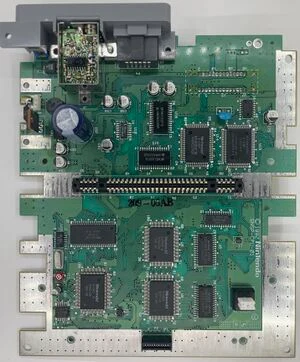 |
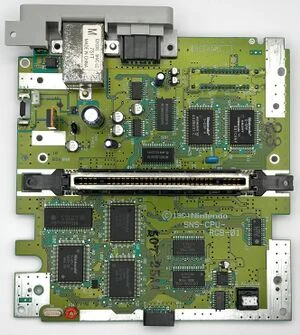
SNSP-CPU-01 SNSP-CPU-02 |
1992 (CPU-01) 1992-1995 (CPU-02) |
PAL | Similar to the GPM-01/02, but adds a circuit which generates 12V DC for SCART autoswitching. This is provided over pin 3 of the multiout (where composite sync is provided on NTSC consoles) and triggers 4:3 mode on some TVs with a SCART input. Board dimensions are the same as the SHVC-CPU-01. Most -02 revisions have a bipolar capacitor at C59 which is part of the 12V circuit; Nintendo used a polarized capacitor at this location on the -01 and older -02 boards, which was prone to failure. The -02 is almost completely identical to the -01 except for an added through-hole at C67 to accommodate a capacitor with smaller lead spacing. |
 |
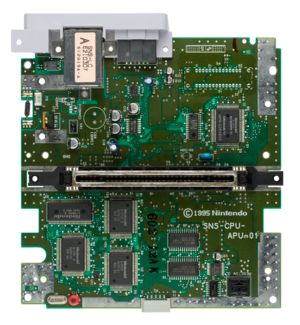
SNS-CPU-RGB-01 SNS-CPU-RGB-02 |
1994-1995 (RGB-01) 1995 (RGB-02) |
NTSC | Has simplified video circuitry featuring the S-RGB video encoder chip. Cartridge port is now soldered directly to the board. The RGB-02 revision has a different audio DAC (NEC uPD6379A) which has balanced audio due to only having a single voltage reference pin. Has video quality issues through RGB and S-video due to a poorly routed color subcarrier trace. |
 |
SNS-CPU-APU-01 | 1995-1996 | NTSC | Consolidates most of the sound hardware into a single chip, the S-APU. Has video quality issues through RGB and S-video due to a poorly routed color subcarrier trace. Last of the 2-chip/3-chip boards. |
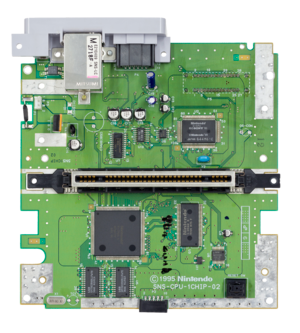 |
SNS-CPU-1CHIP-01 SNS-CPU-1CHIP-02 SNS-CPU-1CHIP-03 |
1995-1996 (1CHIP-01) 1996-1997 (1CHIP-02) 1997 (1CHIP-03) |
NTSC | Consolidates the CPU, PPU1 and PPU2 into a single ASIC. Video quality is considerably sharper but is also overly bright and has some slight ghosting. Also has minor compatibility issues with several games. The -03 revision does not have the circuitry for composite sync populated. |
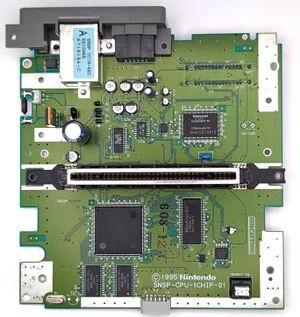 |
SNSP-CPU-1CHIP-01 SNSP-CPU-1CHIP-02 |
1995-1996 (1CHIP-01) 1997 (1CHIP-02) |
PAL | PAL version of the 1CHIP. Almost identical to NTSC 1CHIPs, but still generates 12V DC for SCART autoswitching. |
| (image needed) | SNSM-CPU-1CHIP-01 SNSM-CPU-1CHIP-02 SNSM-CPU-1CHIP-03 |
1995-1996 (1CHIP-01) 1996-1997 (1CHIP-02) 1997 (1CHIP-03) |
Brazil | Nearly identical to the NTSC 1CHIP but outputs PAL-M video. Like its NTSC counterpart, the -03 variant does not have the components for composite sync populated.[1] |
A word about the SHVC-CPU-01
Consoles with an SHVC-CPU-01 board revision have serious longevity concerns, as an increasing number of these consoles are experiencing chip failures. These failures usually afflict the CPU and/or both PPUs, and manifest as issues such as corrupted graphics, booting only certain games, controllers not working, or displaying a black screen. Older consoles with these board revisions and which have the original revision CPU (5A22-01) and PPU2 (5C78-01) are less susceptible, but not immune, to these failures. In addition, these consoles are also beginning to suffer from leaky capacitors, which can cause various problems and can damage the board if not rectified in time. Thankfully, these revisions are easily discerned by looking at the bottom of the console. If it has four rubber feet on the bottom, it will have an SHVC-CPU-01 board. All later board revisions only have two rubber feet at the front. Note that this only applies to NTSC consoles as all PAL consoles have four rubber feet. If you decide to purchase an SHVC-CPU-01 console, make absolutely sure it is fully tested and if possible, run the SNES Burn-In Test in its entirety to ensure the console is actually functioning properly.
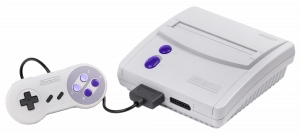
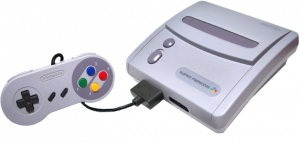
New-Style SNES/Super Famicom Jr. (SNS-101/SNNM-001/SHVC-101)
 |
 |
- Only released in North America (October 1997), Japan (January 1998) and Brazil (1998)
- Complete redesign with a smaller case, no eject button and no expansion port
- Only outputs composite video via the same multiout connector as before; S-video and RGB outputs were removed and RF is only available with an external modulator
- S-video and RGB outputs can be restored by performing an RGB bypass mod or wiring the appropriate pins from the video encoder to the multiout
- Brazilian consoles only have RF out and lack the multiout
- Has only one board revision (SNN-CPU-01) which is heavily based on the 1CHIP revisions
- Because the SNS-101 uses the 1CHIP ASIC, it has all the same issues including the same compatibility problems.
- On the other hand, video output is just as crisp as the 1CHIP consoles
- Replacement cartridge trays are available for the SNS-101 so that Super Famicom games will fit; PAL games still require additional modding
- The Super Famicom Jr. has a cartridge slot which only fits Japanese games
- Despite its missing features, the SNS-101 is a good choice as it has the sharp video output of the 1CHIP consoles but in a smaller package. It also tends to be less expensive than the 1CHIP models since it only has composite video in stock form. RGB and S-video outputs can be easily restored, and once these mods are performed it is essentially on par with an original 1CHIP model. However, it is harder to track down since it was released very late in the SNES's life. It also has all the same aforementioned issues as the 1CHIP consoles.