 | A list of the regional compatibility of every Xbox 360 disc is available there. |
Xbox and Xbox 360 games
From the start, Microsoft decided to give publishers the option to choose the region(s) in which their games would be able to be played.
XeMID
First things first, every original Xbox and Xbox 360 game is identified by its XeMID (Xenon Master ID). Let's take 2 examples : "Alan Wake" (360 game, its XeMID is MS205301W0X11), and a variant of "JSRF: Jet Set Radio Future" (Xbox game, the variant SE01003J will be used).
The first two characters indicate the publisher (for "Alan Wake", MS = Microsoft. For "Jet Set Radio Future", SE = Sega).
2 is the Platform identifier. 2 indicates Xbox 360. Original Xbox games do not have this number, since it was the first platform to receive these IDs.
053 is the game ID. Every title has a unique value, taken from the low-order bytes of the title ID. The combination of the publisher ID and the game ID creates the Title ID, which is what identifies a game (more info here)
The next two digits (01) make the SKU number. This value is unique per SKU for a particular title. Variants of the same game (for example if a game has several releases with different languages) will see this number differ: 01, 02, 03, ... There is no other "Alan Wake" version than this one. However, this is the third variant of "Jet Set Radio Future".
The next letter (W for "Alan Wake", J for "Jet Set Radio Future") indicates the region of the disc.
The last bytes of the XeMID are only present for Xbox 360 games and are less important: 0 is the base version of the title executables on the disc. The order of versions would be 0, 01, 02, 03, ... X indicates a XGD2 disc (a DVD with 7.3 GB of storage) while F indicates a XGD3 disc (a DVD with 8.5 GB of storage), and C indicates a CD. Finally, the last two bytes tell you that it's disc 1 of 1.
If two variants from different regions have the same MediaID, it means that their content is 100% the same, they just have a different label.
Regions
Xbox has three main regions (PAL, NTSC-J and NTSC), so the region letter can either be:
- J for Japan + Korea + Southeast Asia (Taiwan, Hong Kong, Singapore ... Usually it is just called Asia even though it is SE Asia). This corresponds to the NTSC-J region. <-- The Japanese version of "Jet Set Radio Future" is restricted to NTSC-J systems, and will only run on Japanese, Korean, or Asian consoles.
- E for PAL regions (Europe, Oceania, Africa, Middle East, India). This corresponds to the PAL region.
- A for America (North and South). This corresponds to the NTSC region.
- H for J + E (Japan/Asia + Europe/Oceania...)
- K for A + J (America + Japan/Asia)
- L for E + A (America + Europe/Oceania...)
- W for World (J+E+A, effectively all the existing regions) <-- "Alan Wake" is region-free. Since there is no other variant, every regional release of the game will run on every Xbox 360, and contains the exact same data.
An original Xbox console will belong to one of the 3 regions, and will be able to read a disc with a region ID that corresponds to its region. For example, a Canadian Xbox will be able to read discs with a XeMID that has either A, K, L or W as the region letter.
For the Xbox 360, its more complicated. There is more detailed available regions for 360 consoles, and for the games, there is more regions that could in theory be selected by the devs (All, NTSC_ALL, Asia_ALL, Asia_Japan, Asia_Rest, PAL_ALL, PAL_Europe, PAL_Oceania). However, the one-letter region logic was kept, and the region locking was set accordingly for nearly all games. For example, every game whose region letter is K will have its region be Americas + Japan + Rest of Asia. There is only a few known exceptions to this, all being early titles :
| XeMID | MediaID | Name | Region of release | Language(s) | Comments | Regional Lockout |
|---|---|---|---|---|---|---|
| AV200101W0X11 | 7FD5641C | Call of Duty 2 | North America, Europe, Australia | EN only | There is a later revision that makes this game region free | PAL, NTSC, NTSC-J (Japan only) --> not compatibile with non-Japanese NTSC-J 360s |
| AV200601W0X11 | 51EB8DB8 | Quake 2 (Quake 4 Bonus Disc) | World | PAL, NTSC, NTSC-J (excludes Japan) --> not compatible with Japanese NTSC-J 360s | ||
| KO200101J0X11 | 3D4B73BB | Shin Sangoku Musou 4 Special | Japan | JP only | The later Asian variant is basically 100% the same game, but its region is now all of NTSC-J | Japan --> not compatibile with non-Japanese NTSC-J 360s |
| SQ200201J0X11 | 52571AFE | Final Fantasy XI: Online (Beta) | Japan | JP only | Japan --> not compatibile with non-Japanese NTSC-J 360s | |
| SQ200502H0X11 | 2FD31327 | Final Fantasy XI: Online: 2007 Edition | Europe | EN, FR, DE | PAL --> not compatibile with NTSC-J 360s |
 | Since they both use the same region locking system, backward compatible OG Xbox games keep the same region on Xbox 360. If a game's region code was E on the original Xbox, it will also only work on PAL Xbox 360s. However, as the Xbox One and Xbox Series are using a recompiled version of the games, backward compatible Xbox and Xbox 360 games are region free on Xbox One and Xbox Series |
How to find out if a disc is region locked
For the original Xbox, the XeMID was directly written on the disc, on the ringcode. Ringcodes are the small letters and numbers near the center hole of discs. This means it was easy to know to which region they belong.
For example :
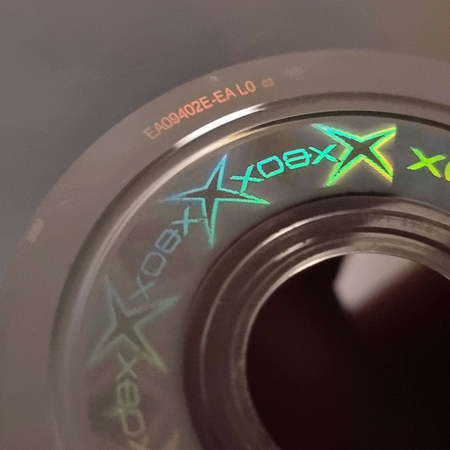
- This is the European copy of Medal of Honor : European Assault, an Xbox game. Its region ID is E (EA09402E), so we can directly see that it is only playable on a PAL OG Xbox.
However, for Xbox 360, the ringcode is not the XeMID, but instead an 8 character code called MediaID (for "Alan Wake": 54E34DF4), that is unique to each XeMID. The XeMID is instead stored somewhere in the files of the game.
For example :
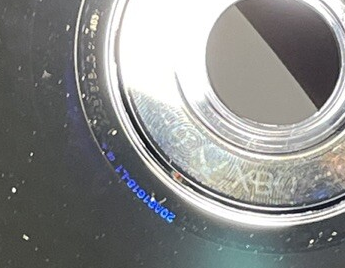
- This game is X-Blades. Here, we see 20A81618. In the game files, the XeMID is SP201501L0X11. The region ID is L, so all the discs that have 20A81618 in the ringcode will be playable in American and PAL (Europe, Oceania, ...) Xbox 360s. If you buy a European copy of X-Blades (and it has 20A81618 in the ringcode), you will be able to play on your American 360, and vice versa.
So, to be able to find out the region(s) of a 360 disc, you will need to go to the wiki's 360 disc list (or alternately Redump, the source of the data), where you will be able to find the unique 8-character code that is on the ringcode of the disc, the XeMID associated with it, as well as the regional compatibility of the disc. Be aware that there could still be missing info and that this database is in perpetual evolution.
Let's take an example: I have a Japanese copy of Batman Arkham Asylum. In the 360 disc database, I can see that the XeMID is SQ203101J0X11. The region ID is J, so you will only be able to play this game using Asian Xbox 360s.
Another example: I have a disc-only version of Sleeping Dogs, with 323C0497 in the ringcode. I want to know if I can use this disc with my American-region 360. If I search for 323C0497 in the 360 disc list, I can see that the region ID is E, so I won't be able to run it on my American 360. Also, I can find here that it's the Spanish and Italian version of the game.
How and why are games and variants region-locked?
There can be several reasons why a game is region-free or region-locked, although there are always some outliers:
- Each variant of a game is in general locked to its target region: the English language variant of a Call of Duty game would be released in the three regions, so they would get the same W-region disc. The French language variant would be released in both France and Québec, so it would be L-region. The Russian language version would only be released in Russian, so it would be E-region. Same for censored variants.
- Historically, all the concurrent consoles had a region-locked system, so in the beginning of the Xbox, there were a lot of region-locked games, whereas the more time passed, the more this tendency disappeared. This is why there is more Xbox 360 games that are not region-locked, compared to the Xbox.
- A lot of Japanese variants of games are region-locked. Even when the other variant is World-region and contains every other language. But as usual, it's a case to case basis.
- The fact that the XeMID works by publisher means that if a game was published by a different publisher in different regions, publishers would restrict their game to their region, and region-lock it.
In fact, the console identifies games using the publisher code + the game ID (for example MS001). This is the reason why some variants have a different set of achievements : their ID is different, so in the eyes of the system, they are two different games.
Difference between variants of the same game
Different versions of the game can have a different region ID. The Japanese version of "Mass Effect" (5F50F8E6 / MS202409J0X11) can only be played on Asian 360s, while all the other variants (70630A1A / MS202406W0X11 (French language, France + Canada(Québec)), 5BE7B26E / MS202407W0X11 (Italian language, Italy), 5ED90C8E / MS202408W0X11 (German language, Germany + Austria), 572BA75D / MS202405W0X11 (English + Spanish language, main World release)) are region-free. The original edition of "Espgaluda II Black Label" (1BFDF0A0 / CZ200803W0X11) is region-free, but the Limited Edition/Shokai Genteiban (66E9DEBC / CZ200802J0X11) is not, and is NTSC-J region only.
Also, the fact that a game can be played in your region's consoles doesn't mean that all the languages will be included in the disc. To give an example, for "Halo: Combat Evolved", in PAL regions:
- MS00403E contains English.
- MS00404E contains French and German. The language is German by default, and will change to french if you set your console's language as French.
- MS00405E contains Spanish and Italian. The language is Spanish by default, and will change to Italian if you set your console's language as Italian.
Another example, all "Fable III" discs are region-free, in every region. However:
- D99E18E7 / MS22601W0X11 contains English voices, with Chinese, Czech, English, Hungarian, Korean Polish, Russian and Slovak subtitles.
- A371069D / MS22602W0X11 contains French voices and subtitles. This was released in French-speaking countries (France, Québec in Canada, maybe in parts of Belgium and Switzerland).
- C22D0F2B / MS22603W0X11 contains German voices and subtitles. This was released in German-speaking countries (Germany, Austria, parts of Switzerland).
- 16003BAB / MS22604W0X11 contains Italian voices and subtitles. This was released in Italy.
- BF2AB004 / MS22605W0X11 contains Castilian Spanish voices and subtitles. This was released in Spain.
- FCC2EE4D / MS22606W0X11 contains Latin American Spanish voices and subtitles. This was released in the Spanish-speaking countries in Latin America.
- 637BECDF / MS22607W0X11 contains Japanese voices and subtitles. This was released in Japan.
You will be able to play all of these on any 360, but you will be restricted to the language of your disc.
Conversely, every variant of a game like "Banjo-Kazooie: Nuts & Bolts" contains all 14 languages, but is region-locked - there are 3 variants that are 100% identical apart from the region letter. That means you will be able to buy a Korean copy and play in Norwegian on a Japanese 360, however on a European 360 you will get the region error screen.
In the end, if you are buying a game and want to know in advance what will be the region code and which language that variant will support, use the list of every xbox 360 disc.
DLC
- DLC can be region-locked or region-free, depending on the game. Your DLC may work out of the box for another region. If not, you can try copying the DLC folder (
00000002) from one region's title ID folder to another and see if it boots up.