Nintendo Switch "V1" (HAC-001)
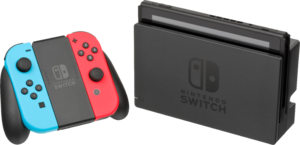
The Nintendo Switch (Codename NX; this revision also having the codename of Iowa) released on March 3rd, 2017. The system measures roughly 4 inches high, 9.4 inches long, and 0.55 inches deep, weighing approximately 0.66 lb. It features a 6.2-inch LCD touchscreen with a resolution of 1280 x 720 at 60 Hz. In docked mode, the Switch can output video up to 1080p 60 FPS. The HAC-001 runs on an NVIDIA Tegra X1 SoC manufactured on a 20 nm process and includes 32 GB of internal eMMC storage, expandable via a microSD card slot behind the kickstand supporting up to 2 TB. The system shipped with accessories including a Joy-Con grip, wrist straps, and the dock.
In terms of connectivity, the Nintendo Switch has Wi-Fi 5 and Bluetooth 4.1, and for I/O the system includes stereo speakers, a 3.5 mm TRRS headphone jack, a game card slot, and USB-C for charging and docking.[1] The console also includes built-in accelerometers, a gyroscope, and a brightness sensor. It uses a 4,310 mAh lithium-ion battery rated for approximately 2.5 to 6 hours on a charge depending on the game; more demanding games such as The Legend of Zelda: Breath of the Wild typically reduce battery life to around 2 to 3 hours. Thus, the original version of the Switch is the least power efficient and potentially the loudest. It also has a flawed microSD card slot design, where the slot is attached to a fragile flex cable PCB, and is connected to the motherboard using a fragile FPC connector. This flawed design causes the microSD slot to prematurely fail (either on the flex PCB or the motherboard's FPC connector) if the microSD card was inserted and ejected too many times.
The early versions of the HAC-001 were also susceptible to the Tegra vulnerability called Fusée Gelée, allowing for homebrew access from the very beginning of the console's life cycle. Due to the impact of this exploit, Nintendo revised these models in July 2018 with new Tegra X1 processors with a patched bootROM[2] that effectively disabled the USB software stack exploit in RCM.
These units carry the serial number prefix of "XA", followed by a region indicator.
Nintendo Switch "V2" (HAC-001(-01))
On July 17, 2019, Nintendo released a revised hardware model of the Switch (with the codename of Icosa) that uses an updated version of the Tegra X1 SoC called the Tegra X1+, manufactured on a 16 nm process. It's usually nicknamed the "V2" model. It was later released in North America in August, and in the United Kingdom in September. The more efficient process node of the Tegra X1+ improves power consumption, allowing for 4.5 - 9 hours of gameplay, in addition to more security mitigations. All other aspects of the HAC-001(-01) are the same as the original, including the microSD slot issue still not being resolved, as it uses the exact same connector and slot module.
This and all future Switch models after the "V2" have to be hardmodded with a modchip in order to boot homebrew; therefore, people prefer using unpatched HAC-001 Switches to have the ability of using CFW without the cost and risk of using soldering equipment, or paying someone to install a chip for you.
The serial number prefix of these models begins with "XK", followed by the region indicator.
Nintendo Switch Lite (HDH-001)
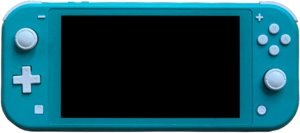
On September 20, 2019, Nintendo announced the Switch Lite (codename Hoag) during a Nintendo Direct (Nintendo's news bulletin relating to new hardware, games, etc.). The Switch Lite was a portable-only handheld console. It couldn't be docked either with the official dock or any third-party alternative, as the video output circuit was physically removed from the motherboard design. The Joy-Cons were not detachable anymore, along with not having any built-in HD Rumble. The handheld came in 3 colors, yellow, turquoise, and gray, with new colors like coral and blue being released later.
All these downgrades allowed for a cheaper price of $299 USD or £199, making it more accessible than the Switch's original price of $399. However, there was poor reception due to Nintendo not fixing any of the issues in the original Switch, like its poor battery life (while it did have the same Tegra X1+ from the HAC-001(-01), it had a physically smaller 3570 mAh battery, causing the battery life to be only slightly better than the Switch V1) and the analog stick degradation, which was worse since the Joy-Con were built into the system, so you would either need to replace your Lite or do a lengthy teardown to replace the stick modules themselves.
For what it's worth, Nintendo did fix one of the design flaws of the original Switch, the fragile microSD card slot, by soldering it directly to the motherboard instead of using a fragile FPC connector. This is likely more of a coincidence, as soldering the microSD card slot to the motherboard makes manufacturing cheaper and easier, which was the main goal of the Switch Lite in the first place.
The serial number prefix of Switch Lites begin with "XJ", followed by the region indicator.
Nintendo Switch ― OLED Model (HEG-001)
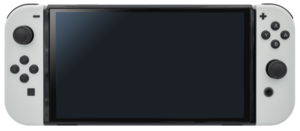
The OLED model (codename Aula) was released on October 25, 2021, along with Metroid Dread. It was a major improvement over the original HAC-001 and HAC-001(-01) Switches. It had a 7-inch OLED display allowing for dark blacks and smaller bezels. Furthermore, it also had an upgraded 64 GB of internal eMMC storage, better speakers, a better, larger built-in kickstand rather than the original Switch's flimsy bit of plastic, and an improved dock with built-in Ethernet, replacing the USB 3.0 port. Curiously, the OLED Model's dock is also theoretically capable of 4K video output, but this can only be utilized on modified consoles.
The OLED model also continued to have a more reliable microSD card slot design like the Switch Lite, but it has the game cartridge slot and microSD slot attached together on one large daughterboard, which connects to the motherboard with a much more robust FPC connector than what was used on the HAC-001's microSD card board.
The serial numbers of these models begin with "XT", followed by the region indicator.