This page serves as a reference for information on each version of the Xbox 360. All the recommendations are objective with no bias for the appearance of the console.
Every Xbox 360 revision except for Barracuda (also known as Winchester) models can be RGHed; however, the modding process and recommended exploit will vary between models. See the Getting Started page for more information.
Console Configurations
 | While retail consoles configured with a hard drive never came with internal or external memory units, it was very common for users to upgrade 256/512 MB Arcade consoles and 4 GB S/E consoles with a hard drive. Keep this in mind when buying a used console. |
Xbox 360 "Phat/Fat" (2005-2010)
 |
 |
 |
|---|
"Jump in."
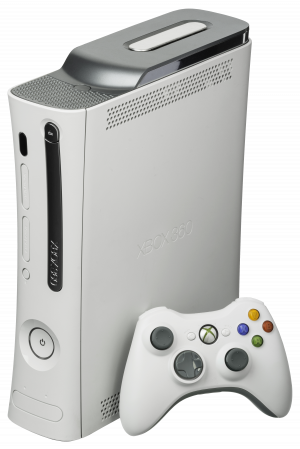
- Original version of the console, often given the nickname of "Phat" or "Fat" because it had the largest size. The CPU and GPU on the original models are separate chips, like many older consoles.
- Since it's the oldest version of the Xbox 360, these tend to have the least amount of features with the highest power consumption compared to the S/E models (especially on the early Xenon/Zephyr motherboards)
- Features 1 rear USB port, 2 front USB ports, no internal Wi-Fi card (Wi-Fi can be obtained on original models with official and third-party dongles), no built-in optical audio port (can be obtained with an AV cable or adapter), and no Kinect port.
- Unlike the S and E, the hard drive is a large module on the top/side of the console and clips into place. The HDD shell has an internal adapter to convert a standard 2.5" SATA HDD to a proprietary connector.
- All models feature an A/V video output. This port supports composite, component, and VGA video outputs in addition to RCA and optical audio output. CPU and GPU are separate chips with their own heat sinks.
- Xenon, Elpis, and Opus consoles only have an A/V connector, but all other board revisions (Zephyr, Falcon, Jasper, and Tonasket) also include an HDMI port.
- Fan units for phat consoles include two fans to cool the CPU and GPU.
Xbox 360 Core
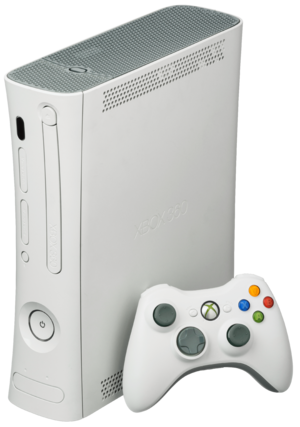
This is the original base model retail SKU for the Xbox 360 and didn't come with any hard drive or memory units. The DVD drive and eject button were color-matched to the matte white shell, unlike HDD models. These only featured Xenon or Zephyr motherboards. Some of these consoles, which were officially refurbished by Microsoft service centers, may have received an Opus motherboard, but these are uncommon. Thus, these models never feature HDMI output.
Xbox 360 (With Hard Drive)
"Go Pro"
This is the most common retail configuration of the Xbox 360 and came with either a 20 GB or, later on, a 60 GB hard drive with a white shell. They are colloquially known as the "Premium" or "Pro" models. These consoles came with a chrome DVD tray bezel and matching eject button. They came with various motherboards, including Xenon boards. While Xenon versions of these models didn't feature HDMI, they were later revised with HDMI-capable motherboards.
Xbox 360 Arcade
"Go Play!"
The Xbox 360 Arcade was essentially a reintroduction of the Xbox 360 Core, but with updated Falcon/Jasper/Tonasket motherboards that feature HDMI. These also have a white DVD tray bezel with a matching eject button. The Arcade SKU also included a 256 MB or 512 MB memory unit. On Falcon models, an external 256 MB memory unit was included in the box. However, on Jasper & Tonasket Arcade models, the memory unit was integrated into the console's NAND. Arcade consoles with Jasper boards can either have 256 MB or 512 MB NANDs, but Arcade consoles with Tonasket motherboards always come with 512 MB NANDs.
Xbox 360 Elite
"Go Big"
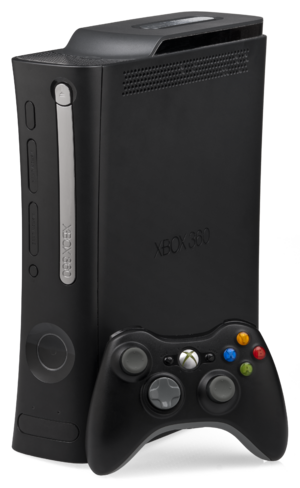
This model is the same as the standard white model, but with a 120 GB HDD and always comes with HDMI. It featured a black shell and a chrome DVD tray bezel. It was the first SKU that officially featured HDMI and the first to use the Zephyr motherboard. Later on, they came with Falcon, Jasper, and Tonasket boards.
"Super Elite"
In 2010, there were also limited edition Elites that came with 250 GB HDDs. These came in a few bundles and always feature Tonasket motherboards. Sometimes these are colloquially known as "super elites" and have the same appearance as normal elites.
- Halo 3 with Halo 3: ODST Special Edition Bundle (Canada only).
- Tom Clancy's Splinter Cell: Conviction Special Edition Bundle.
- Forza Motorsport 3 Special Edition Bundle.
Special Editions
Special edition consoles often came with special HDD sizes that normally required a separate purchase with standard models (except for the Resident Evil 5 bundle). These consoles also came with a special shell and faceplate design. All 250 GB models feature Tonasket (also known as Jasper Kronos) motherboards.
- Halo 3 special edition consoles came with either Zephyr or Falcon motherboards, unique game-themed shells with matching HDD shells, and 60 GB hard drives.
- Resident Evil 5 special edition bundles came with 120 GB HDDs and Jasper motherboards with a red shell.
- Modern Warfare 2 special edition bundles came with 250 GB HDDs, a unique game-themed black shell, and Tonasket motherboards.
- Final Fantasy XIII special edition bundles came with 250 GB HDDs, an extra game-themed faceplate (not preinstalled), a unique HDD shell, and a 250 GB HDD. The shell has the same external appearance as standard white consoles.
DVD Drives
The original Xbox 360 had four DVD drive revisions. The first model was the Toshiba-Samsung TS-H943 (name shortened to Samsung), included with early Xenons. Later drive models are the Hitachi-LG GDR-3120L (name shortened to Hitachi), Philips & BenQ VAD6038 (name shortened to "BenQ"), and the Philips & Lite-On DG-16D2S. (name shortened to "Lite-On", "Phat Lite-On", or the drive model [DG-16D2S]). All of these drives can be easily flashed without soldering or any special tools. However, extracting the DVD key from a DG-16D2S without modding the console it was paired to requires more steps.
The Hitachi drives are notable for being the quietest models while having much better reliability than the BenQ or Lite-On drives. The BenQ and Lite-On drives have similar reliability to each other, but the Lite-On models have a much louder laser pickup and motor unless they are relubed/oiled. As for the early Samsung drives, while their laser reliability is decent, they tend to have issues with their plastic parts being severely fragile over time, resulting in them also having the unfortunate nickname of the "crumple drive".
- Xenon consoles originally came with Toshiba-Samsung drives, while later Xenons came with a Hitachi-LG drive. Xenons refurbished by Microsoft usually come with a Philips & BenQ VAD6038 or Philips & Lite-On DG-16D2S.
- Zephyr consoles can come with either a GDR-3120L (earlier models) or VAD6038 (Microsoft refurb and later manufactured consoles) drive. Refurbished Zephyr consoles can also come with DG-16D2S drives.
- Falcon consoles can come with a GDR-3120L (earliest models), VAD6038 (Microsoft refurbs and mid-lifecycle Falcons), or DG-16D2S (Microsoft refurbs and late lifecycle Falcons).
- Some non-HDMI consoles can come with Opus motherboards, which are just Falcons without HDMI. Like most 2008-2011 consoles, they usually come with Lite-On drives but may also come with BenQ drives.
- Jasper and Tonasket consoles only come with DG-16D2S drives.
Motherboard Comparison
| Name | PCB Part # | Photo | CPU | GPU/eDRAM | 12V Amps | Flash | Description |
|---|---|---|---|---|---|---|---|
| Xenon | X803600-011 | 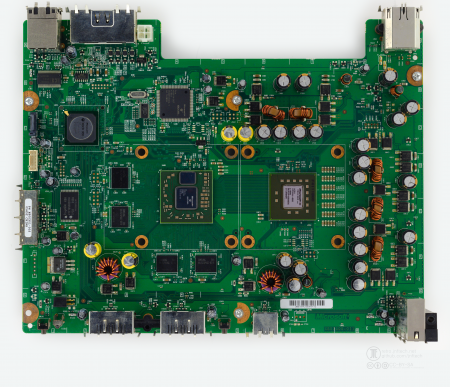
|
90 nm Waternoose DD2, DD2.1, or DD3 | 90 nm Y1 w/ 90 nm Edifis | 16.5A | 16 MB NAND | Typical MFG date: 2005 through early 2007 First ever motherboard model used on the Xbox 360. Does not feature HDMI. Uses ANA encoder/DAC chip, unlike future motherboards. Early consoles have a small GPU heatsink, but later manufactured consoles come with an extended GPU heatsink. Xenons originally came with unreliable CPU capacitors and low Tg underfill on the GPU, causing them to be very unreliable. Some consoles feature either a fixed Y1 or Elpis, indicating they were refurbished. Note: CPU capacitors may still be defective even on refurbished Xenons like the Elpis. Avoid these consoles unless they have an official manufacture/service date sticker from Q2 2008 or later. |
| Elpis | Same as Xenon | 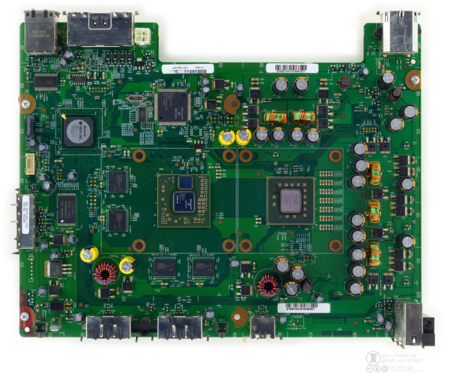
|
90 nm Elpis w/ Styx-65 | Typical service date: 2009 or later Essentially a Xenon, but refurbished with a new GPU. The firmware was also modified to support the Elpis GPU on Xenon. The Elpis GPU is similar to the Rhea used on Zephyr_C and Falcon/Opus, but is always fixed. Note: CPU capacitors may still be defective even on refurbished Xenons like the Elpis. | |||
| Zephyr_A/B/C | A: X810385-004
B/C: X810387-006/007 |
|
90nm Waternoose DD3 | 90 nm Y1 w/ 90 nm Edifis (A) 90 nm Y2 w/ 90 nm Edifis (B) 90 nm Rhea w/ Styx-90 (C) |
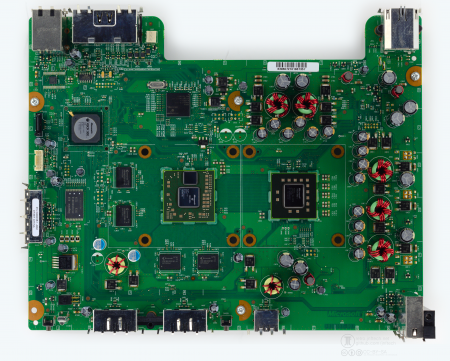
Typical MFG date: Early 2007 to late 2007 First motherboard to feature HDMI. Significantly redesigned compared to the Xenon. Replaces the ANA chip with the HANA chip, which integrated the clock generator and supported HDMI. The HANA would go on to be used on all future phat boards and Trinity slims. Zephyr was originally only on Elite SKUs, but later trickled down to the standard white model. Zephyr_A features the same Y1 from the Xenon and slim GPU heat sink, Zephyr_B features the Y2 with an improved GPU heatsink, and Zephyr_C revisions feature the Rhea. Unfortunately, like the Xenon, GPUs on these all three versions also had low Tg underfill, causing poor GPU reliability. | ||
| Falcon | X812320-003 | 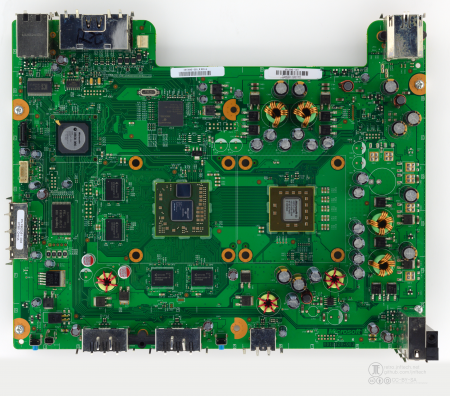
|
65 nm Loki | 90 nm Rhea w/ Styx-90 | 14.2A | Typical MFG date: Late 2007 to October 2008 This motherboard revision was the first to use a 65 nm CPU, alongside a cheaper power delivery system. Very early Falcon consoles use the same CPU heat sink with a copper heat pipe on Zephyr/Xenon, but later on the CPU heat sink was replaced with a cheaper and larger full aluminum heat sink. At sometime in March 2008, the Rhea GPU was fixed to use high Tg underfill, fixing GPU reliability issues. Though, these fixed Rhea GPUs haven't actually been seen installed into consoles until late April. Thus, it's best to avoid Falcon consoles if the manufacture/service date is before April 2008. Falcon consoles manufactured or serviced during or after May 2008 tend to have good reliability. | |
| Opus | Same as Falcon | (image needed) | Same as Falcon, but only used on some refurbished consoles from 2008 that previously used a Xenon board. As such, these don't feature HDMI. Instead, they have a unique AV port soldered onto a standard Falcon PCB. Curiously, the Opus AV port is unique from the Xenon ones. These also always feature a fixed GPU. In terms of non-HDMI motherboards used for refurbished Xenon consoles, these motherboards tend to be uncommon compared to Elpis boards or Xenon boards with replaced GPUs. | ||||
| Jasper | X815842-002 | 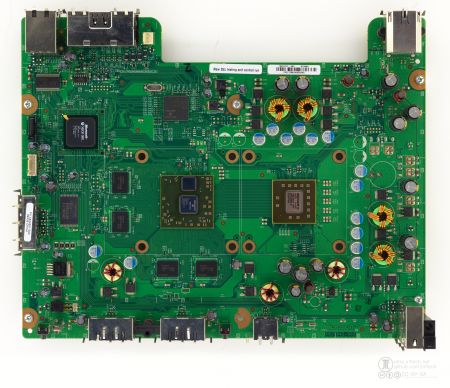
|
65 nm Zeus* w/ Styx-90 | 12.1A | 16 MB, 256 MB, or 512 MB NAND | Typical MFG date: November 2008 to mid 2009 Another phat motherboard revision. It now features the 65 nm Zeus GPU, new PSB south bridge, and Arcade models integrate a memory unit into the NAND. This also means dashboard updates can be stored on the NAND, rather than needing the hard drive. This, along with the Tonasket, are generally regarded as the most reliable motherboard models. Some of these consoles when brand new also patched the JTAG exploit. | |
| Tonasket | X820379-001 | 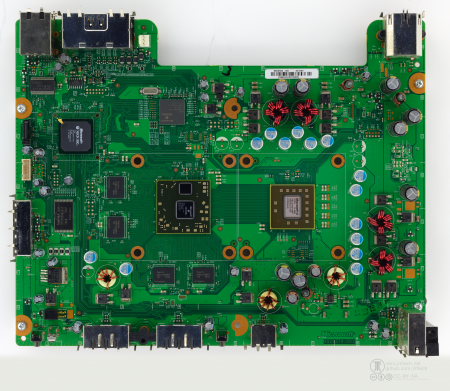
|
65 nm Kronos w/ Styx-65 | 16 MB or 512 MB NAND | Typical MFG date: Late 2009 to mid 2010 Also known as "Jasper V2" or "Jasper Kronos". Tonasket is a minor revision of the Jasper with a new GPU that has shrunken eDRAM. The PCB layout was also slightly cleaned up to remove the majority of unused traces. All of these motherboards patched the JTAG exploit even when brand new due to having the patched bootloader at that point, but can still be RGHed. Stock RF board was changed, but is still compatible with older model RF boards. The GPU heat sink was reverted to the slim heat sink without the extra copper heat pipe, like on early Xenons and Zephyr_A. This model is generally regarded as the most reliable, and technically has the lowest power draw of all Phat motherboards. |
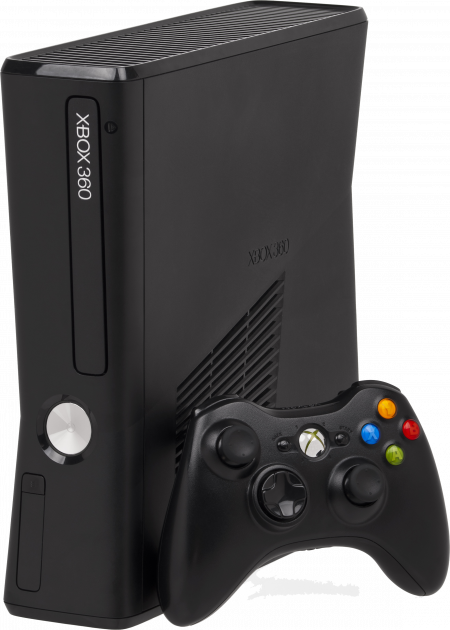
Xbox 360 S (2010-2013)
- Major redesign of the console. It is often nicknamed the "Slim", as it was reduced in size, power consumption, and noise compared to the original console while being a fitting stand-in for the letter S.
- Integrated the XCPU, Xenos GPU, and eDRAM into one multi-chip module called the XCGPU, also known as the Vejle. The cooling system was thus redesigned to be a single heatsink/fan to accommodate this new chip design.
- It features 2 front USB ports, 3 rear USB ports, a dedicated Kinect port, A/V and HDMI video outputs, built-in 2.4 GHz Wi-Fi, and integrated optical audio. The connector on the Wi-Fi cards they use looks visually similar to USB, but it's a bit wider and cannot be easily plugged into a PC or original 360.
- Power/eject buttons are touch sensitive and integrated in the faceplate rather than the RF board.
- The power supply connector was changed to make original power supplies incompatible, but older Xbox 360 power supplies can be converted to work on an S with cheap adapters.
- Xbox 360 S consoles come with an internal beeper speaker, which plays unique chimes when the power or eject button is pressed on the console. Most special edition S consoles also have unique power/eject sounds and feature a larger speaker.
- The naming scheme of the original Xbox 360 SKUs was ditched to only be for the default storage. Retail SKUs consisted of a 4 GB memory unit (onboard NAND with Corona/Waitsburg consoles), a 250 GB HDD, or, in special editions, a 320 GB HDD. The 320 GB HDD was also sold separately.
- The internal HDD now uses a direct SATA connection, unlike the original Xbox 360.
- S consoles featured Trinity, Corona, and Waitsburg motherboards. Waitsburg is a minor revision of Corona that changed the 4 GB NAND configuration to a combined BGA chip instead of a 4 GB TSOP with an external controller.
- Black 4 GB models always have a matte shell, but early HDD models came with a glossy shell. Those early HDD models will also always be Trinity consoles.
- Corona & Waitsburg consoles with a black case are always matte, regardless of factory storage size.
Special Editions
Special edition Corona consoles came with special HDD sizes that normally required a separate purchase with standard models.
- Halo Reach special edition bundles came with Trinity motherboards, unique game-themed shells with matching power/eject sounds, and 250 GB hard drives.
- Gears of War 3 special edition consoles came with Trinity motherboards, unique game-themed shells with matching power/eject sounds, and 250 GB hard drives.
- Modern Warfare 3 special edition console bundles come with Corona 16 MB motherboards, unique game-themed shells with matching power/eject sounds, and 320 GB hard drives.
- Star Wars special edition bundles come with Corona 16 MB motherboards, a special R2-D2-themed shell with matching power/eject sounds, white RF board LEDs with a blue diffuser, and 320 GB hard drives.
- Glossy white Xbox 360 S systems come with Waitsburg motherboards and standard power/eject sounds.
- For this special edition, there are both 4 GB SKUs (which come with a motherboard that has a 4 GB NAND without a hard drive) and 320 GB HDD SKUs (which instead come with a motherboard that has 16 MB internal NAND)
- Halo 4 special edition bundles came with Waitsburg 16 MB motherboards, unique game-themed shells with matching power/eject sounds, white RF board LEDs with a blue diffuser, and 320 GB hard drives.
DVD Drives
The Xbox 360 S has three DVD drive revisions.
- The Philips & Lite-On DG-16D4S is the earliest DVD drive revision and comes with the majority of Trinity consoles. Early Corona consoles may come with it too. They are notable for being the only S DVD drive that is exploitable without replacing the stock PCB.
- Some versions of the DG-16D4S also came with a Winbond flash. These drives require the infamous Kamikaze exploit to enable read/write access, whereas other drives had an MXIC flash chip, which could be unlocked with just voltage injection in one of the drive controller's pins.
- The Philips & Lite-On DG-16D5S is an updated version of the DG-16D4S that fixed the security issues of the old drive. The DVD key cannot be extracted, and the drive's firmware cannot be flashed. Consoles that come with this drive model require Bad Update or RGH to grab the DVD key from the console's keyvault rather than the DVD drive itself. These come with most Coronas and every Xbox 360 S/E made or serviced during and after 2011. The actual metal shell and laser pickup mechanism are the same; the only difference is the PCB. This means that it is possible to swap the PCB with either an aftermarket or original 16D4S daughterboard, which are flashable.
- The Hitachi-LG DL10N was used as an alternative to the Lite-On drives. It could come with any Xbox 360 S/E but tends to be uncommon. The DSP & flash chip on the DL10N doesn't have a known exploit, meaning you cannot extract the DVD key without an RGH/Bad Update exploit to the console it was paired to or flash new firmware on it without replacing the PCB with an unlocked aftermarket one. That being said, the daughterboard on DL10N drives has zero soldered wires, making a PCB replacement easier to do compared to a 16D4S or 16D5S.
Motherboard Comparison
| Name | PCB Part # | Photo | XCGPU | EDRAM | Flash | 12V Amps | Description |
|---|---|---|---|---|---|---|---|
| Trinity | X850590-003 | 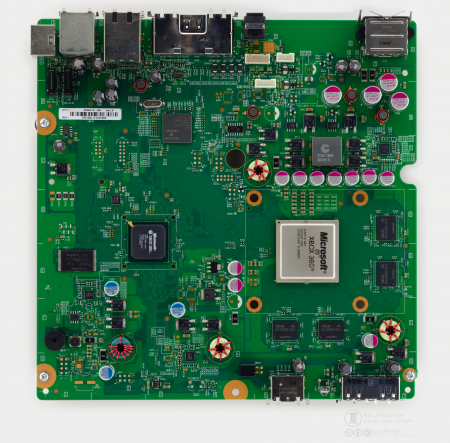
|
45 nm Vejle | Styx-65 | 16 MB NAND | 10.83A | Typical MFG date: Mid-2010 to July 2011 Major redesign of the motherboard to accommodate for the new Xbox 360 S. The PCB is smaller and combined the XCPU and GPU into one chip. Still uses the same south bridge and flash configs from the Jasper/Tonasket. Trinity consoles that come with 4 GB memory units have them as detachable modules, unlike on Coronas. Trinities are generally regarded as one of the more reliable models, second to Jasper/Tonasket. A few of these have had instances of dead CGPUs, but these are generally in the minority. |
| Corona | X857330-003 and/or X859085-00x | 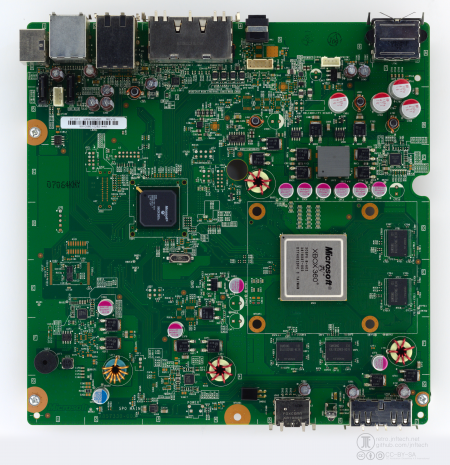
|
16 MB NAND or 4 GB MMC | 9.6A | Typical MFG date: August 2011 through 2012 Also known as the "Corona V1" (16 MB) or "V2" (4 GB NAND). Similar to Trinity, but with several more unified components to make the console cheaper to produce and draw a bit less power. The HANA encoder chip and Ethernet PHY have been integrated in a new KSB south bridge, and it now supported on-board 4 GB NANDs. 4 GB Memory units are now integrated into a 4 GB NAND with a Phison PS7000 controller. Unfortunately, Guitar Hero games developed by Neversoft have audio de-sync during game play caused by the new south bridge. This also happens in future Corona revisions (Waitsburg/Stingray) and the Barracuda, as they also have a KSB. The audio desync does not affect other rhythm games or older motherboard versions. Some very late productions of the Corona PCB (X857330-004) also had the trace going to the POST_OUT pad from the CPU to the bottom of the board was also removed, in an attempt to combat the Reset Glitch Hack. This minor change ended up being a fruitless endeavor, as someone can easily use a postfix adapter (or even solder a wire directly on the corresponding BGA ball under the CPU, although this is significantly harder) to easily gain access to POST, and thus a successful RGH. If possible, try to avoid Coronas that have a 4 GB NAND. The Phison PS7000 chips on these consoles commonly fail overtime. If you do have one, try to minimize usage of the memory unit. The memory unit can also be disabled after an RGH. | ||
| Waitsburg | X862605-002 | 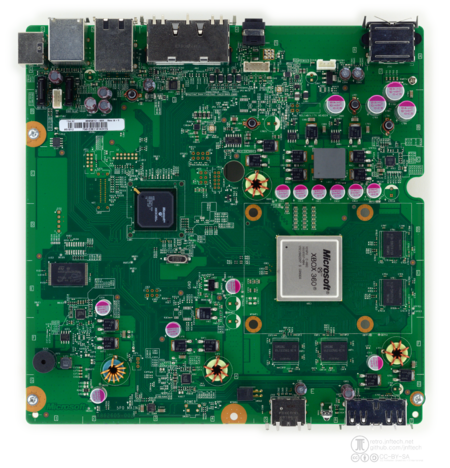
|
16 MB NAND or 4 GB eMMC | Typical MFG date: 2012 through 2013 Also known as "Corona V3" (16 MB NAND) or "V4" (4 GB eMMC). This motherboard is a minor revision to the Corona. On 4 GB SKUs, it changed the 4 GB TSOP NAND + Phison PS7000 controller to a combined eMMC chip. In addition, the CPU not having the traces connected to the POST vias has become standard. If possible, try to avoid Waitsburgs that have a 4 GB NAND. The 4 GB Hynix NAND chips on these consoles commonly fail overtime. If you do have one, try to minimize usage of the memory unit. The memory unit can also be disabled after an RGH. |
Xbox 360 E (2013-2016)
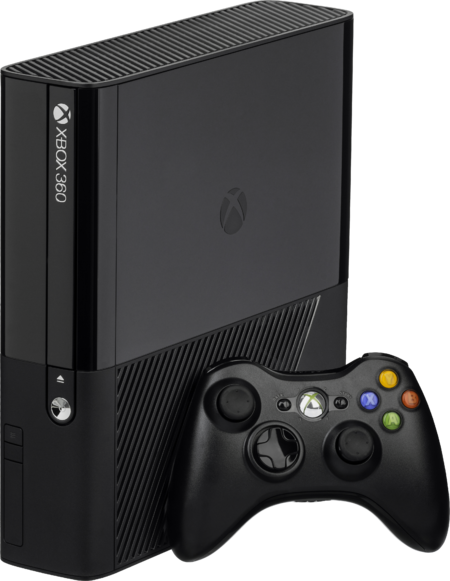
- This is the last version of the Xbox 360 released. It is essentially a repackaged Xbox 360 S but has some components and I/O removed for cheaper manufacturing costs.
- It removed one of the rear USB ports, integrated an optical audio port, and replaced the A/V port with a 3.5mm composite video output connector, making VGA and component no longer compatible.
- It replaced the capacitive power/eject buttons on the faceplate with mechanical buttons. The RF board and power/eject buttons are separate PCBs, but the RF boards from the Xbox 360 S can still be used on the E.
- This model removed the components for power/eject sounds. On the earlier Stingray motherboards, the solder pads for audio hardware still exist.
- Power supply now uses a single barrel jack, but power supplies for the original Xbox 360 can be converted to work with an E with cheap adapters.
- These consoles also featured 4 GB NAND and 250 GB HDD SKUs like the S but introduced 500 GB HDD SKUs later in production.
- Xbox 360 E hard drives are the same as the S hard drives and are compatible with each other.
- Earlier E models came with Stingray motherboards (these were like Corona/Waitsburg boards from the 360 S but removed the aforementioned features and still have no POST point) and are RGH-able just like S.
- In late 2014, the Stingray boards were replaced with Barracuda boards. Barracuda consoles currently can only be temporarily modded/tethered via the software-only hypervisor exploit, "Bad Update". Generally, Xbox 360 E consoles made after August 2014 are most likely Barracudas.
Special Edition
There was only one special version of the Xbox 360 E ever released, and it was a Walmart exclusive. It was colored dark blue with teal side panels while being bundled with a 500 GB HDD, Call of Duty: Black Ops II, and Call of Duty: Ghosts. These usually came with Barracuda motherboards, but there are some early examples of these systems that came with Stingray motherboards.
DVD Drives
Potential DVD drives for all Xbox 360 Es are either the Philips & Lite-On DG-16D5S or the Hitachi-LG DL10N. The stock PCBs of them cannot be flashed, and the DVD key cannot be extracted without RGHing or running Bad Update on the console.
Motherboard Comparison
| Name | PCB Part # | Photo | XCGPU | EDRAM | Flash | 12V Amps | Description |
|---|---|---|---|---|---|---|---|
| Stingray | X854326-004 | 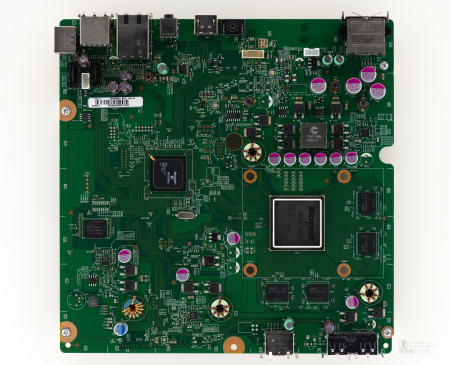
|
45 nm Vejle | Styx-65 | 16 MB NAND or 4 GB eMMC | 9.6A | Typical MFG date: 2013 to mid 2014 Also known as "Corona V5" (16 MB NAND) or "V6" (4 GB eMMC). This is the motherboard used in early Xbox 360 E consoles. It is another minor revision to Corona, but with some components removed to make the console even cheaper to produce. It carries over the hidden POST point from the Waitsburg. The power supply connector was changed from a two barrel connector to a single barrel. If possible, try to avoid Stingrays that have a 4 GB NAND. The 4 GB NAND chips on these consoles commonly fail overtime. If you do have a Hynix 4 GB console, try to minimize usage of the memory unit. The memory unit can also be disabled after an RGH. |
| Barracuda | X879957-004 | 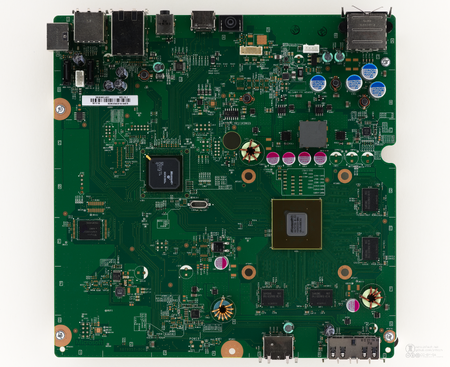
|
32 nm Oban | Typical MFG date: August 2014 to 2015 Also known by its unreleased predessessor's name, "Winchester". Notable for being the final Xbox 360 motherboard revision, and was used in late productions of the Xbox 360 E. This motherboard has been drastically simplified in order to reduce manufacturing costs even further. Most of the solder pads for previously unused components were removed. The Vejle was also replaced with a new 32 nm Oban CGPU, which integrated the eDRAM into the CPU/GPU die. This CGPU also patched the Reset Glitch Hack by filtering the POST and reset lines on the new CGPU while disabling the pins used to slow down the clock speed, like PLL and EXT_CLK. Thus, all Barracuda motherboards don't have a known hardware exploit at this time, but can still be exploited with Bad Update. If possible, try to avoid Barracudas that have a 4 GB NAND. The 4 GB NAND chips on these consoles commonly fail overtime. If you do have a Hynix 4 GB console, try to minimize usage of the memory unit. | |||
Motherboard Identification
If you want to identify a console motherboard, you can either use Octal450's identification wizard or the following identification chart.
Identification Chart (All models)
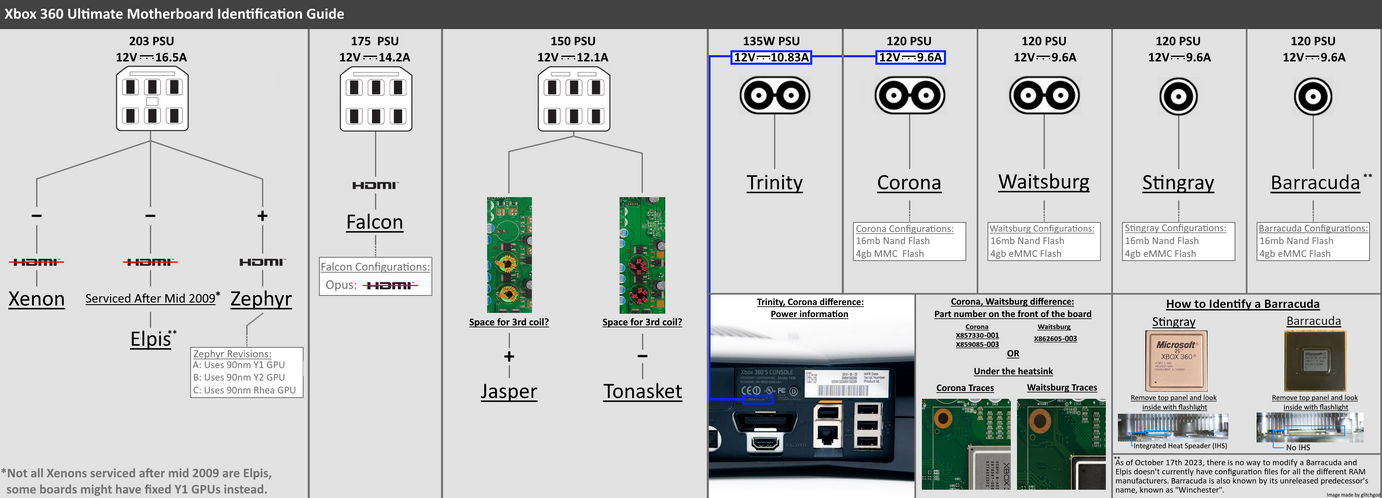
In some instances, used Xenons and Zephyrs may have the middle pin broken off (either intentionally or unintentionally). Pay close attention to the middle of the connector if you are unsure.
PCB Part Number
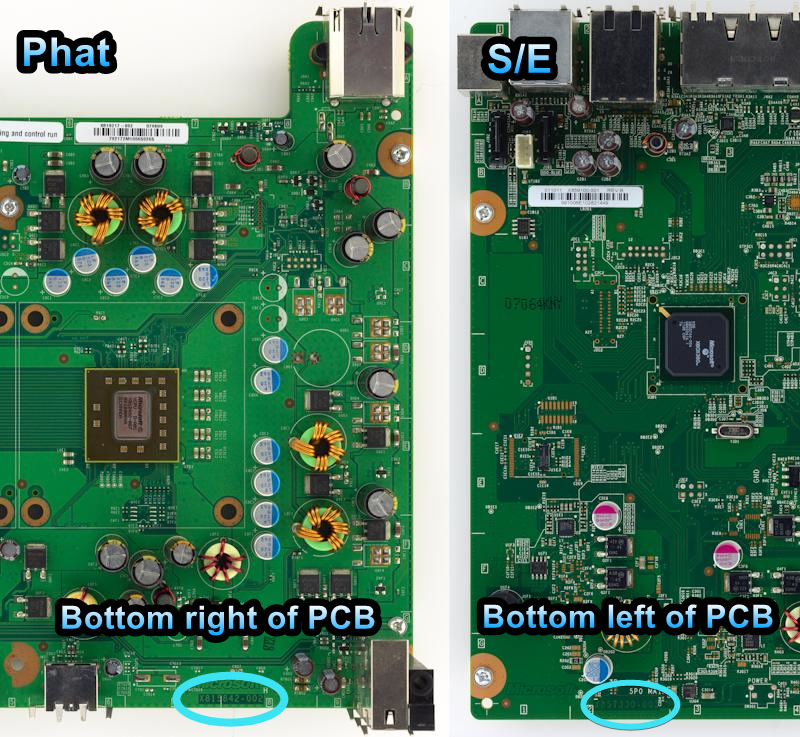
Xbox 360 motherboards come with part numbers on the PCB, which can be used to easily identify a motherboard revision. On phat motherboards, the part number will be on the bottom right next to the USB ports. On S/E motherboards, it is on the bottom left next to the Microsoft logo.
It should be noted that 4 GB Coronas may have an additional number for their build up ID, and it will be towards the left of the PCB's part number. The PCB part number will be circled in the following image.
Xbox 360 S
Trinity vs. Corona
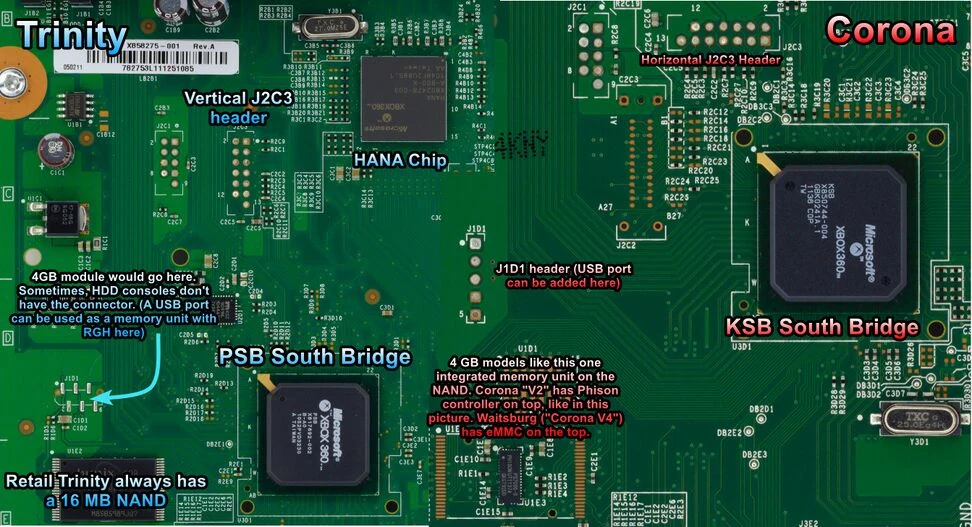
If you have an Xbox 360 S, you can easily identify a Trinity console with the listed amperage on the rear sticker. Trinity consoles use 10.83A, whereas Corona/Waitsburg consoles use 9.6A. Early S consoles with a glossy case came with a Trinity board and a 250 GB hard drive, but ones that came with a 4 GB memory unit came with a matte case. Later on, Trinities that shipped with hard drives were also switched to a matte case. 4 GB Trinity slims had the memory unit on a daughterboard, with the main NAND still being 16 MB.
Black Corona/Waitsburg consoles were always matte, whether they were a 4 GB NAND or 250 GB HDD SKU. 4 GB Corona/Waitsburg slims instead had the 4 GB memory unit built onto the board as the main NAND, thus making NAND dumps require different tools and steps. When opening the console, Trinity motherboards also have several distinctive features compared to Corona boards.
Corona Vs. Waitsburg
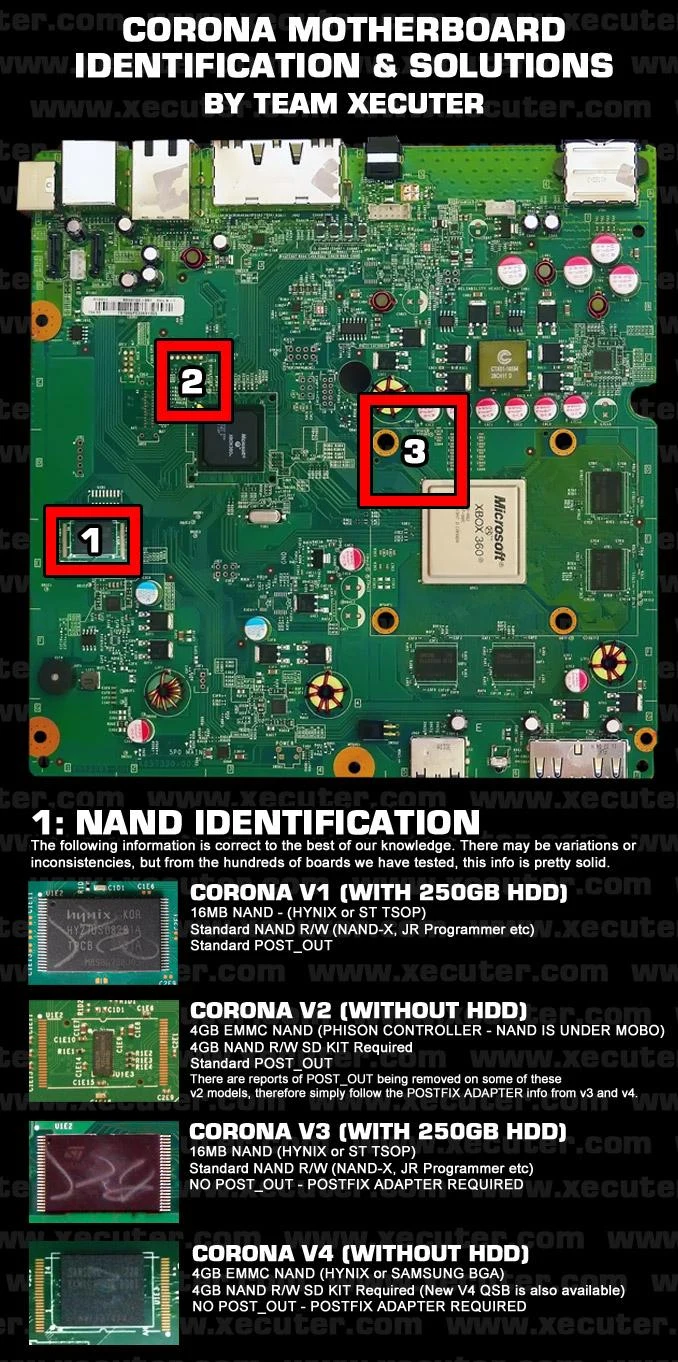
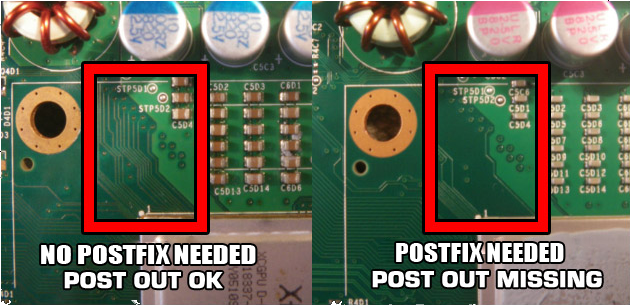
If you have a Corona based console, you can identify if it's a Corona "V1/V2" or Waitsburg ("Corona V3/V4") using the provided images. The Waitsburgs will not have traces from the CPU going to POST, which means you will need a POSTFix adapter to successfully use RGH. 4 GB SKUs also have a BGA153 eMMC without the Phison controller. If you have a Corona/Waitsburg console that has a 16 MB NAND, the only ways to identify the revision are either by taking off the CPU heatsink or checking the PCB part number.
Xbox 360 E
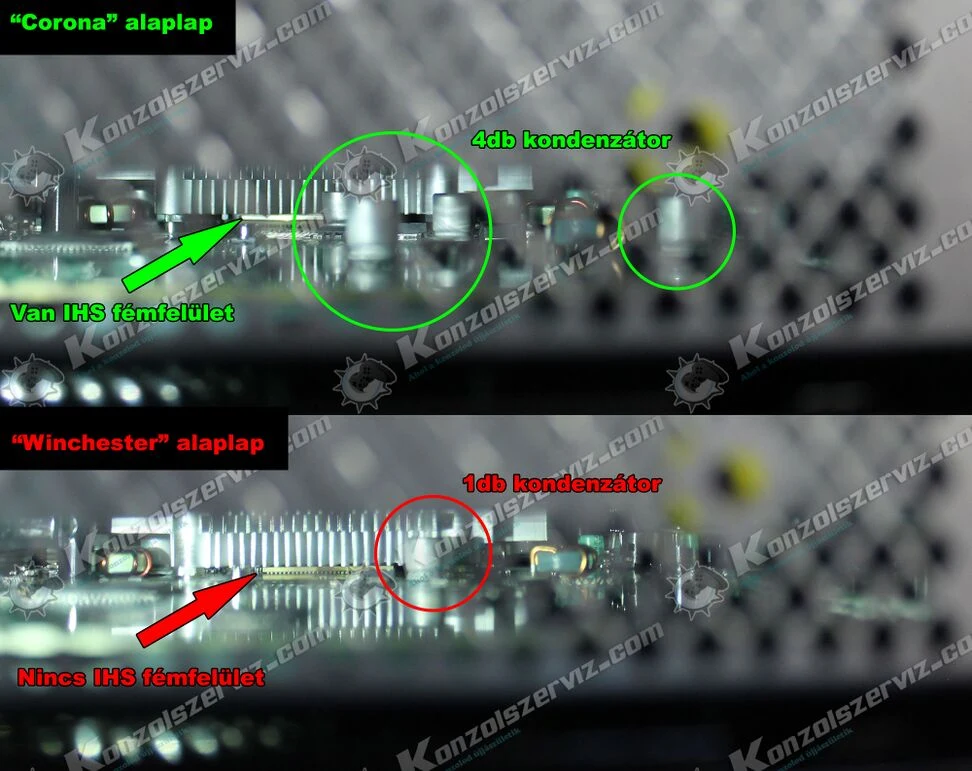
If you have an Xbox 360 E, you either can use this video guide or reference this image (make sure to take off the top shell cover) and shine a flashlight through the side to determine if it has a Stingray ("Corona V5/V6") or Barracuda ("Winchester") motherboard.
Other
The Niveus EDGE is a presumed second-party repackaging of an original Xbox 360 for the home theater market.